Contents:

Learn: Online tutor
Learn moreEmotional learning has deep roots; its importance was discussed by ancient philosophers. In the modern world, this topic has acquired particular relevance. The acronym SEL, which stands for social-emotional learning, appeared in the 1990s, but it has only recently become popular in Russia. In this article, we will take a closer look at what SEL is and how it influences personal development.
What is SEL
The term SEL translates from English as social emotional learning. Although this approach does not have a single, clear definition, three key goals can be identified. First, SEL is aimed at developing emotional literacy, which helps people better manage their emotions. Second, it promotes the formation of social skills necessary for successful interaction with others. Third, a social-emotional learning program helps strengthen personal qualities such as self-confidence and the ability to self-reflect. Integrating SEL into educational settings and everyday life promotes harmonious personal development and improves the quality of interpersonal relationships.
- develop students' emotional intelligence;
- create an emotionally comfortable environment in which students feel valued and can express themselves as individuals;
- inspire and motivate learning through emotions.
SEL (social-emotional learning) is a learning technology, not a separate academic discipline. It should not be considered a separate subject, such as psychology or social studies. Social-emotional learning is integrated into the overall curriculum, and a key task for teachers is to establish a strong connection with students. This allows for the design of lessons in a way that is more personalized and promotes the development of social and emotional skills in students. Effectively integrating SEL into the educational process can significantly improve student engagement and emotional well-being.
The primary mission of SEL is to create a positive social-emotional environment for students. It aims to develop skills in recognizing and managing their emotions, as well as effective interactions with others. SEL helps children learn to build healthy relationships, cope with challenges, and develop emotional literacy, which contributes to their overall well-being and successful adaptation in society.

Read also:
Education in ancient times is an important aspect of the development of human culture and science. In ancient Greece, education was focused on preparing citizens for participation in the life of the polis. It included the study of philosophy, rhetoric, mathematics, and physics. The emphasis was on developing critical thinking and oratory skills.
Education also played a significant role in ancient Rome, although the Roman system was more practical and aimed at preparing for public service. The Romans borrowed many aspects of Greek education but emphasized law, history, and military strategy. The study of Latin language and literature became an important element of Roman education.
Despite differences in approaches, ancient education laid the foundations for the further development of educational systems in the Middle Ages and modern times. It contributed to the formation of intellectual traditions that still influence modern education. Understanding ancient education is important for understanding its contribution to the development of world culture and science.
How and when this approach appeared
SEL (Social and Emotional Learning) began to develop in the United States in the late 1960s. At that time, child psychologist James Comer, together with colleagues from the Yale Child Study Center, implemented the Comer School Development program, created for two of the most disadvantaged schools in New Haven. This program became the basis for the further development of the concept of social and emotional learning, aimed at improving the educational process and supporting the emotional well-being of students.
The Comer program aimed to create a comfortable educational environment in schools in which students felt valued and loved. The main focus was on solving problems through dialogue and empathy, rather than through strict teaching methods. Parents, school psychologists, and health workers actively participated in the initiative. By the 1980s, the program's results were evident in schools achieving above-average academic performance, and behavioral and truancy problems had virtually disappeared. The effectiveness of Comer's program underscores the importance of a comprehensive approach to education, where all stakeholders work as a team to achieve the best results.

Ideas for Schools Operating in Challenging Conditions
Schools operating in challenging conditions require creative approaches and innovative solutions. Here are five ideas that can help educational institutions address these challenges and ensure high-quality learning.
The first thing to consider is the implementation of distance learning technologies. Online learning allows teachers to continue teaching even when traditional methods are unavailable. The use of educational platforms and video calls helps maintain the connection between students and teachers.
The second is the creation of curricula adapted to local conditions. This may include the use of local resources that will help teachers integrate practical tasks into the learning process, for example, using natural resources or cultural characteristics of the region.
Third is the creation of support communities for parents and students. This could be an online group or regular meetings where students discuss emerging issues and struggles. Sharing experiences and supporting each other can significantly improve the school atmosphere.
Fourth is the implementation of mental health programs. In times of stress and uncertainty, it is important to care for the psycho-emotional state of students and teachers. Regular self-development and psychological support sessions can help create a healthier educational environment.
Finally, it is worth considering partnerships with local communities and organizations. Collaboration with NGOs, businesses, and government agencies can provide schools with the resources and support needed to address current challenges.
These approaches will help schools operating in challenging conditions not only survive but also thrive, providing a quality education for all students.
The success of Comer's program has attracted the attention of education experts. In the 1980s, the W. T. Grant Consortium was launched with support from the William T. Grant Foundation. The project's experts developed a framework for implementing social-emotional learning, which became the foundation for developing key competencies in students. Key skills that can be developed through this learning process include the ability to identify, assess, and control one's emotions, as well as empathy and tolerance for others. Thus, social-emotional learning contributes not only to the student's personal growth but also to the creation of a harmonious educational environment.
In the 1990s, social-emotional learning gained widespread popularity. In 1994, CASEL (Collaborative to Advance Social and Emotional Learning) was founded, which today serves as the official representative of the SEL concept. That same year, the Fetzer Institute held the first CASEL conference, bringing together teachers and researchers studying issues of violence and drug use in American schools. These events marked a significant milestone in the development of teaching methods aimed at improving the emotional and social well-being of students.
The real boom in interest in emotional intelligence in psychology and pedagogy began thanks to the American psychologist Daniel Goleman. In his books of the 1990s, he asked why people with average IQs achieve greater success than those who demonstrate high academic achievement. This discussion drew attention not only to Goleman's work but also to the concept of social-emotional learning, which emphasizes the importance of developing emotional skills for success in various areas of life. Emotional intelligence became a key concept in understanding the interaction between emotions and behavior, which has significant implications for both education and personal life.
In the following decades, the psychologist actively emphasized the importance of emotional intelligence, engaging more and more education professionals in the discussion. Despite existing skepticism and criticism, many educational institutions have begun implementing social-emotional learning (SEL) programs in an effort to enhance their students' social and emotional skills. These experiments have become an important step toward creating a more harmonious educational environment that fosters holistic personal development.
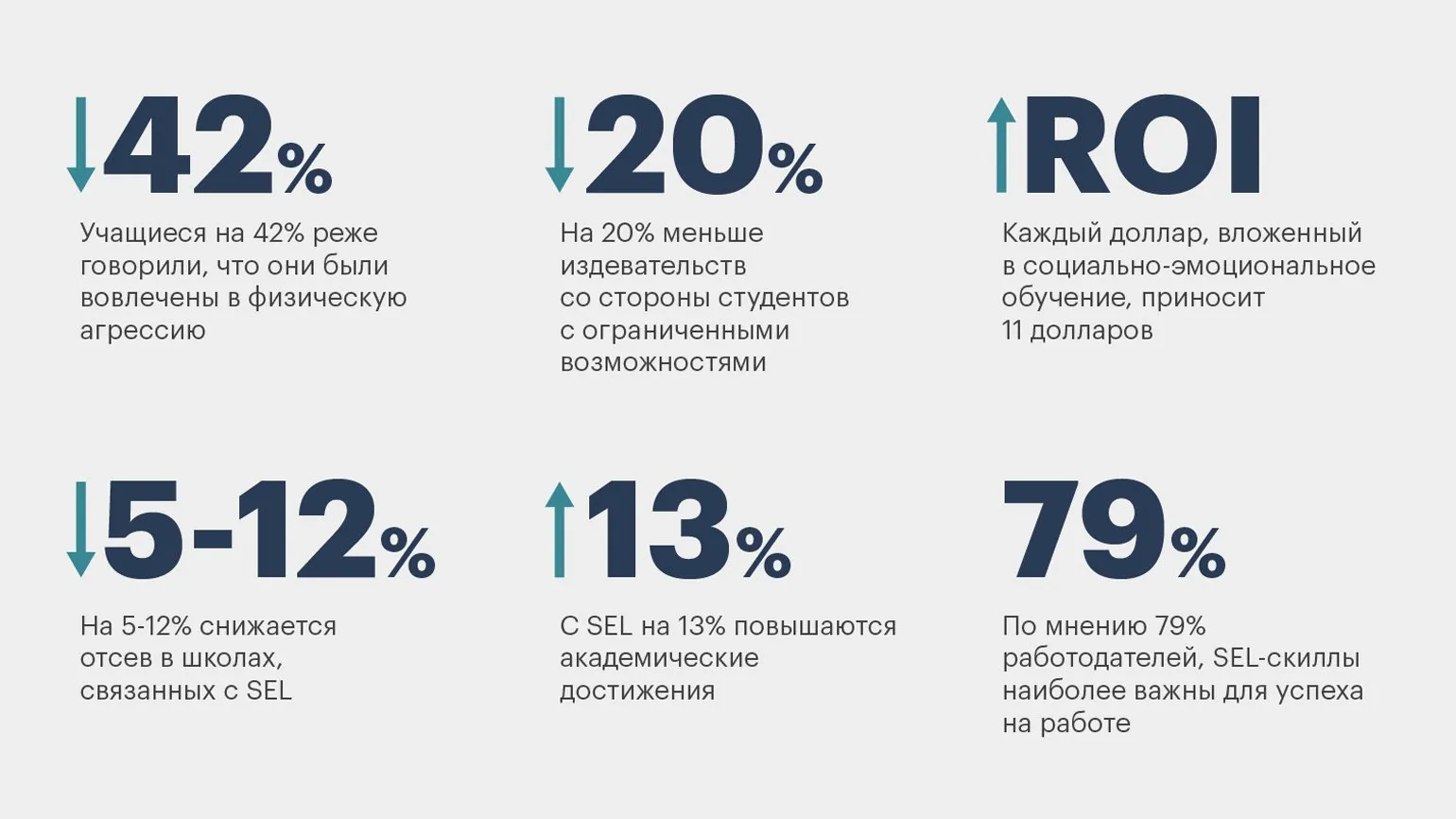
In the late 2010s, the topic of emotional intelligence and social-emotional learning (SEL) began to be actively discussed in Russia. In 2018, the Institute of Education Management of the Russian Academy of Education, together with the Department of Psychology at the National Research University Higher School of Economics, held a seminar in which researchers emphasized the importance of SEL and analyzed Russian experience, as well as the challenges educators face in implementing this approach in their practice. In 2020, a group of international researchers presented a meta-analysis of SEL results, confirming that students with high levels of emotional intelligence achieve greater academic success. This highlights the importance of integrating emotional intelligence into the educational process to enhance student learning and development.
Why SEL is so much talked about now
The pandemic has significantly exacerbated the problems associated with the lack of social-emotional learning. Students and teachers around the world faced high levels of stress during lockdowns. For many teachers, distance learning became a real challenge: in addition to technical difficulties, they experienced difficulty supervising students online. Students, in turn, noted that distance learning became a real test for their psychological well-being. These circumstances highlight the importance of social-emotional learning, which has become critically necessary in today's environment.
The popularization of social-emotional learning (SEL) is largely due to the increased demand for soft skills. According to a 2020 World Economic Forum report, by 2025, skills such as critical thinking, creativity, emotional intelligence, leadership, and the ability to learn quickly will be particularly in demand. These changes are driven by new approaches to teamwork, which require specialists not only technical knowledge but also the ability to effectively collaborate with others. Developing these skills is becoming a key factor for success in the modern world.
The labor market is rapidly changing under the influence of downshifting and remote work trends. Generation Z, or zoomers, is increasingly choosing to maintain their mental and physical health by foregoing high-pressure careers. In today's environment, employers must adapt to this new reality, recognizing that employees are unwilling to sacrifice their well-being for career advancement. In this regard, it becomes extremely important for managers to establish strong personal contacts with subordinates, which helps create a healthy and productive working atmosphere.

Read also:
Teaching students and employees team skills is an important part of their professional and personal development. Effective teamwork skills promote better teamwork, increase productivity, and create a positive workplace environment.
The first step in teaching team skills is to develop an understanding of the importance of teamwork. It is important to explain how collaboration influences the achievement of shared goals and the success of a project. Next, a program should be developed that includes practical exercises and training that will help develop skills such as communication, conflict resolution, leadership, and role distribution.
The use of role-playing games and simulations can significantly enhance the learning process. These methods allow participants to immerse themselves in real-life scenarios where they can practice their skills in a safe environment. It is also helpful to organize group projects that require collaboration and the exchange of ideas.
Regular feedback is a key element in training. Students and employees should receive constructive feedback on their work in a team to understand their strengths and weaknesses. In addition, it is important to encourage self-reflection so that participants can analyze their actions and improve their approaches to collaboration.
For successful team skills training, it is necessary to create a supportive atmosphere where each participant feels valued and heard. This will help build trust within the team and improve its overall effectiveness.
In conclusion, teaching team skills is an investment in the development of both students and employees. These skills are the foundation for the successful functioning of any team and contribute to the achievement of common goals.
How SEL Works
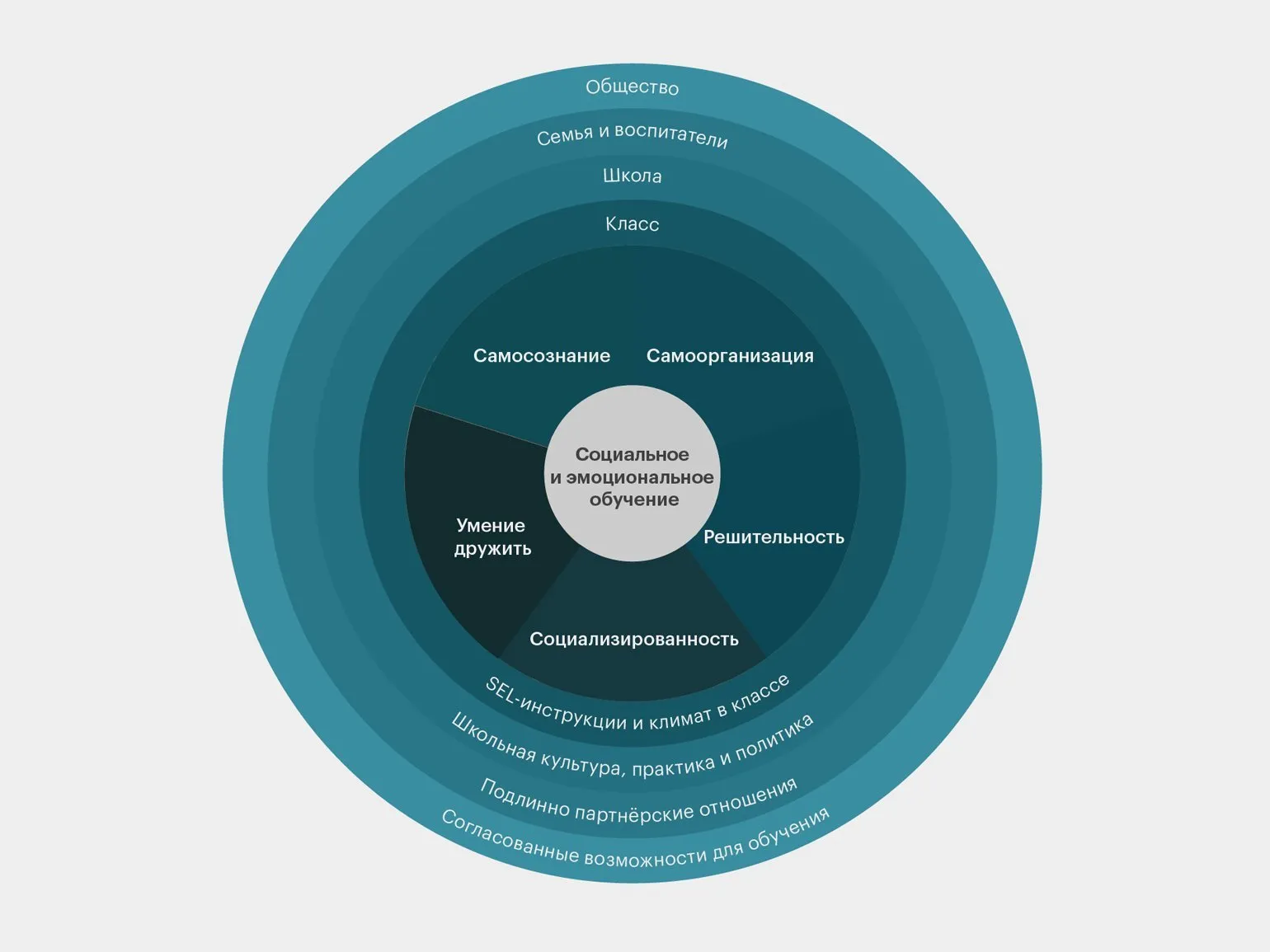
The CASEL organization identifies five key competencies that need to be developed in students as part of social-emotional learning. These competencies include self-awareness, emotion management, social awareness, relationship skills, and decision-making. Developing these skills contributes to the formation of emotionally stable and socially responsible individuals. Social-emotional learning plays an important role in the educational process, helping children better understand their emotions and interact with others. Supporting these competencies in school helps create a positive atmosphere, which in turn improves academic achievement and the overall well-being of students.
- Self-Awareness. The ability to understand and analyze one's own emotions, thoughts, and values, and how they influence behavior in different contexts.
- Self-control. The ability to control emotions and thoughts in different situations, and the ability to manage them to achieve set goals.
- Social awareness. The ability to understand and show empathy for another person, even if your views, culture, and upbringing are completely different from each other.
- Relationships with others. The ability to establish and maintain close, healthy contact with people.
- Responsible decision-making. The ability to make constructive decisions and behave appropriately in different situations.
CASEL provides valuable guidance on developing a value system and integrating social-emotional learning (SEL) into the educational process. Briefly, the main recommendations consist of the following key steps:
- Create a dedicated SEL team.
- This team should develop an SEL implementation plan, as well as a school value system based on surveys of students, their parents, teachers, and the entire community. The fundamental question is: what kind of school should a student want to be a part of?
- Then, SEL specialists need to select a proven methodology or propose their own ideas that align with the school's values.
- After this, the changes should affect the entire educational institution—for example, the school may initially decide to hold class hours on Fridays, during which students share their impressions of the past week.
- Monitor the situation further—evaluate effectiveness, modify, and supplement any approaches that are not working.
All of these recommendations require additional financial investments, time, and specialized staff training. Furthermore, existing frameworks do not provide ready-made templates that teachers could use in their lessons. Since the primary focus is on developing soft skills and establishing a strong personal connection with students, technology initially places high demands on teachers for flexibility, creativity, and empathy. It's important to remember that the successful implementation of these recommendations directly depends on teachers' willingness to adapt to new conditions and embrace innovative approaches to teaching.
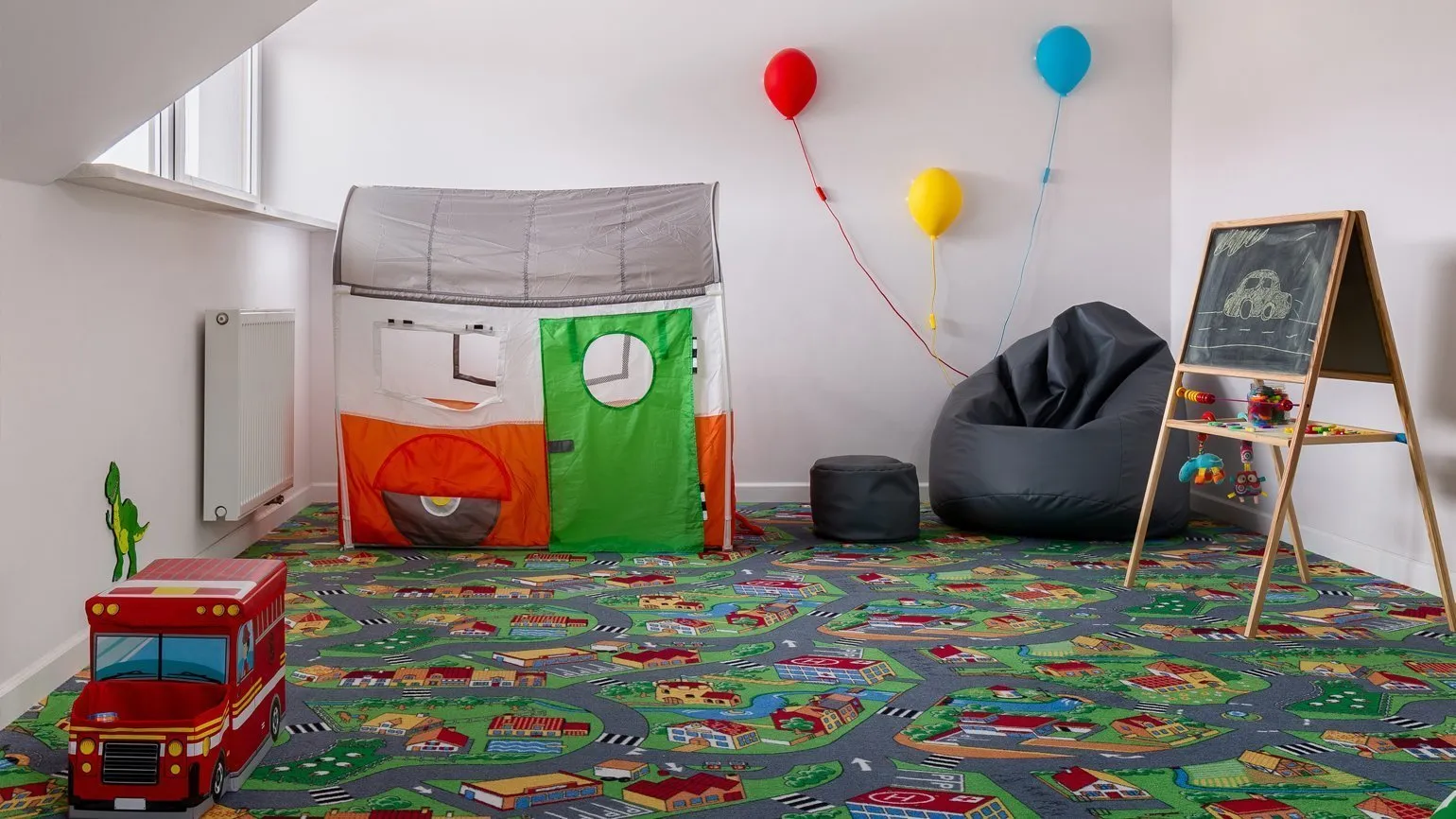
In practice, different teachers and educational institutions are adapting this system in their own ways. Some schools are completely revising their work organization, hiring qualified psychologists and actively involving parents in the educational process, which facilitates more effective homeschooling. Other institutions are changing the classroom atmosphere, creating stress-relief areas to improve students' psychological well-being. This approach helps improve the quality of education and promotes the development of a harmonious educational environment.
Some teachers prefer to integrate social-emotional learning (SEL) directly into the educational process. To do this, they use game-based activities, often dividing the class into groups or pairs, which promotes teamwork skills. They also use short warm-ups, engaging in casual conversations with students or playing games with them. This approach helps create a more comfortable and supportive classroom atmosphere, which positively impacts learning and interaction between students. American teacher Barry White developed a unique approach to greeting his students by introducing individualized handshaking styles. According to him, this method not only strengthens relationships with the children and increases trust, but also charges them with positive energy throughout the lesson. This approach helps create a more comfortable classroom atmosphere and increases student motivation, which in turn improves the learning process.
SEL (Social and Emotional Learning) is harmoniously integrated into the humanities. In literature and history lessons, the volume of reflective essays can be increased and historical events or scenes from fiction can be simulated. This will help students develop emotional intelligence, critical thinking, and collaboration, which are important skills in modern society. Integrating SEL into the classroom fosters deeper understanding of the material and develops the personal qualities needed for a successful life and career. Student feedback is an important practice in the educational process. Many teachers encourage their students to keep journals where they can share their emotions and opinions about past lessons. While brief oral surveys are theoretically possible, in practice this requires more time, and introverted students may feel uncomfortable. Journaling provides a more comfortable and thoughtful opportunity for each student to express their thoughts, which helps improve the educational process and increase engagement.

Revised text:
Explore additional materials:
Interview with a supporter of a human-centered school
In this interview, we consider the views and ideas of a supporter of a human-centered school, which emphasizes the importance of human factors in the educational process. A human-centered school is based on the principles of respect, support, and an individual approach to each student. We will discuss how these principles influence student learning and development, as well as the role of teachers and parents in creating a comfortable educational environment. It is important to understand how a human-centered approach can change traditional teaching methods and promote more successful knowledge acquisition. During the discussion, we will also touch on examples of successful practices that demonstrate the effectiveness of this approach in various educational institutions.
Another fashionable trend or essential technology?
One of the main reasons for criticism of social-emotional learning (SEL) is the lack of specific methods and clear approaches to teaching, which makes it difficult to objectively evaluate the final results. Without further ado, many SEL slogans seem reminiscent of conventional wisdom about the importance of caring for students and the need to pay more attention to their emotional well-being. The internet offers numerous recommendations for creating effective SEL lessons, as well as articles describing how SEL helps teachers unleash their creative potential. However, critics argue that the lack of control in SEL technology can negatively impact the educational system. The vagueness of the concepts allows for various interpretations, which, in turn, can lead to the use of SEL as a tool for ideological manipulation. It is important to develop clear frameworks and standards for the application of SEL to ensure its effectiveness and protect the educational process from potential abuse. In early 2020, during a discussion of the SEL project in Idaho, a member of the House Education Committee drew an analogy between emotional control and behavioral tuning to Aldous Huxley's dystopian novel Brave New World. Some participants in the discussion expressed the opinion that social-emotional education should be the responsibility of parents, not the educational system.
There are many questions to which SEL does not yet have clear answers. The most pressing of them are:
- What values should teachers instill: progressive or traditional, and why not vice versa?
- How to measure results?
- How sincere will emotions be if a person constantly uses them to achieve their goals?
- What is a comfortable social-emotional environment and is it the same for everyone?
- Is it even possible to develop and structure a clear SEL program?
The approach to social-emotional learning (SEL) is not yet effective for adolescents. Although the goal of SEL seems inspiring, proponents of this method have a long way to go to cope with the questions and problems that arise. More research and tailored approaches are needed to better meet the needs of young people and effectively integrate social-emotional learning into their lives.
Currently, the social-emotional learning (SEL) approach has not yet achieved the necessary structure for large-scale implementation in educational institutions. However, technology is spurring the education sector to more actively discuss the development of soft skills and inspiring enthusiastic teachers to experiment in this area. Given today's increasingly digital society and its preference for online interaction, communication and emotional management skills are becoming as important as computer and financial literacy. It is important that educational programs integrate SEL to help students adapt to a rapidly changing world and interact effectively in a variety of life situations.
Revised text:
Be sure to read additional information:
- How to assess student success: unusual ways
- School without desire is a school of violence
- How modern approaches put the student at the center of learning
- What is social learning theory
Online Tutor
It doesn't matter what you teach—English, CrossFit, yoga, vocals, or culinary arts. Everything you previously taught in schools, studios, and offices can now be taught online. Promote your knowledge and skills and earn money from anywhere in the world.
Find out more