
Contents:

Learn: The Profession of a Methodologist from Scratch to PRO
Learn More
Research Fellow and Deputy Director of the Center for the Sociology of Higher Education at the HSE Institute of Education and a lecturer at the Institute of Education. She holds a PhD in education, having defended her dissertation on self-regulated learning in massive open online courses. Specializes in research in the field of educational technologies and their impact on the learning process.
Photo from the personal archive of Ksenia Vilkova.
In this interview, you will learn about:
- what skills make up self-regulated learning and how this relates to success in online courses;
- how the ability to self-regulate learning is related to the age of students;
- is it possible to measure the level of self-regulated learning and is it worth relying on the collection of digital data for this;
- do online students benefit from tips on how to effectively study independently;
- how instructors can help students develop self-regulated learning skills.
When did the concept of self-regulated learning appear and what does it mean?
Self-regulated learning is an approach in which the learner actively manages their educational process. This method assumes that the student takes responsibility for setting goals, planning their learning, monitoring their progress, and evaluating their results. Self-regulated learning helps develop self-control, critical thinking, and adaptability skills, which promotes deeper learning and increases motivation. This approach is especially effective in dynamic educational environments, as it helps students better adapt to change and independently find solutions to emerging problems.
The term "self-regulated learning" is a tracing of the English expression "self-regulated learning." A more common definition in Russian is "educational self-regulation." This concept should not be considered a separate theory; rather, it represents one of the modern concepts explaining the learning process. Self-regulation encompasses a wide range of skills and strategies that help students manage their own learning, set goals, plan actions, and evaluate achievements. Self-regulated learning is a process in which students actively set their educational goals and monitor their progress toward them. This cyclical approach emphasizes not only self-monitoring but also consideration of external factors that influence the learning process. Students who employ self-regulation strategies can effectively adapt to changes in the educational environment, which facilitates deeper acquisition of knowledge and skills. The ability to manage one's own learning varies among individuals. Some are highly self-organized and can effectively regulate their learning processes, while others require external monitoring and support. It is important to understand that the level of self-regulation can depend on many factors, including personality, motivation, and the environment. This emphasizes the importance of an individualized approach in the educational process to address the needs of each student and help them develop self-control skills.
Learning self-regulation depends largely on individual characteristics, but it is also closely linked to environmental factors. Important aspects include the stimuli provided by the learning environment, as well as how students interact with peers and teachers. Without taking into account environmental influences, it is impossible to achieve a high level of self-regulated learning.
Research into this process has been ongoing since scientists began to recognize its significance and impact on various aspects of life. The first steps in studying this phenomenon were taken at the beginning of the 20th century, when the first theoretical developments and practical experiments appeared. Since then, interest in this process has increased, leading to in-depth analysis and numerous studies covering its mechanisms, applications, and consequences. Modern research continues to reveal new aspects, confirming the relevance and importance of the topic in the scientific community.
The first studies of self-regulated learning began in the 1980s. The main models developed in this field are based on Albert Bandura's social cognitive theory. Key aspects of this theory include concepts such as self-reinforcement, self-efficacy, and self-control. These principles play a key role in understanding how individuals can manage their own learning, set goals, and achieve them. Research in this area continues to evolve, opening new horizons in educational methods and psychology. Recent years have seen a significant increase in interest in research on academic self-regulation, largely due to the pandemic and the rise in popularity of online education. More and more people are beginning to acquire new knowledge independently, without the direct involvement of teachers. This has led to an increase in research on self-regulated learning and further development of this concept. Self-regulation in the educational process is becoming an important aspect, allowing students to more effectively manage their learning and achieve their goals.

Self-regulated learning is related to a number of concepts in pedagogy, including autonomous learning, metacognition, and self-efficacy. These terms reflect important aspects of the learning process in which students take responsibility for their education. Autonomous learning emphasizes students' ability to independently manage their learning process, while metacognition involves awareness and control over their own cognitive processes. Self-efficacy, in turn, refers to students' confidence in their ability to achieve their goals. In Russian theories, such as activity theory, self-regulated learning also plays a key role, emphasizing the student's active role in the learning process and their ability to self-organize and self-control. These concepts are interrelated and provide the basis for developing effective learning strategies, which is important for both teachers and students.
The concept of self-regulated learning emerged in the United States, but in my dissertation, I relied on international research. Reviewers and senior colleagues noted that there are also scientific schools in Russia studying this topic. For example, it is worth mentioning Vasily Davydov's theory of learning activity, as well as the work of Varvara Morosanova and her colleagues on the psychology of self-regulation. This research is conducted at the Laboratory of Self-Regulation Psychology and makes a significant contribution to the understanding of self-regulation, including its educational aspects.
Most studies by Soviet and Russian scientists do not offer adequate tools for measuring self-regulated learning. In this regard, foreign studies have proven more useful and informative for analyzing this topic.
How Academic Self-Regulation Works
Self-regulated learning includes a number of key skills that help students effectively manage their educational process. These skills include setting goals, planning learning activities, self-monitoring, and assessing progress. The ability to independently identify one's learning needs and choose appropriate learning strategies also plays an important role. Furthermore, it's important to develop reflective skills, which allow you to analyze your achievements and adjust your approaches to achieve better results. Mastering these skills promotes a deeper understanding of the material and increases student independence.
There are many competing models of learning self-regulation. Personally, I am most drawn to the model proposed by Barry Zimmerman, which I used in my dissertation. This model is simple and accessible, allowing for a better understanding of the processes occurring during learning. However, it cannot be considered the primary or generally accepted model of self-regulated learning.
Zimmerman argues that self-regulated learning is a cyclical process consisting of three key stages: planning, action, and reflection. These stages are interconnected and form a continuous cycle. The essence of the method is that the learning process should not stop. After the reflection stage, planning for the next step follows. A person begins with planning their learning, then moves on to active learning, after which they analyze their results, draw conclusions, and return to the planning stage again. This approach promotes deeper absorption of the material and the development of self-regulation skills in learning.
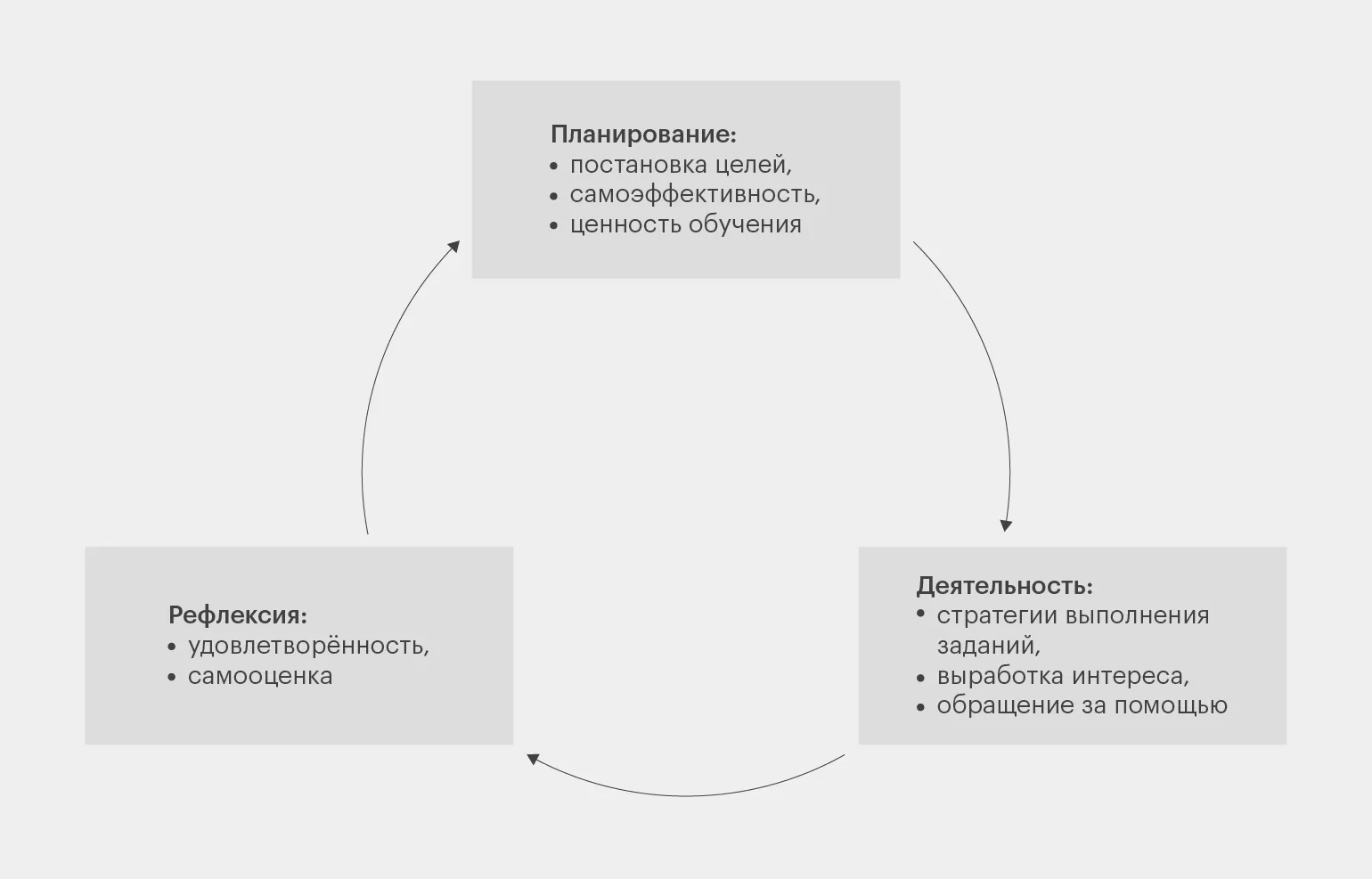
In practice, problems most often arise at various stages of the process. One of the most challenging stages is planning, when it is necessary to precisely define goals and resources. Difficulties also often arise during the implementation stage, when teams face unforeseen circumstances and constraints. Verifying and evaluating results can also be challenging, especially if the analysis methods are not clearly defined. It is important to carefully consider each stage to minimize risks and maximize efficiency.
In my dissertation research, I analyzed learners of massive open online courses (MOOCs) and examined ways to improve the effectiveness of their self-regulated learning. An important task was to determine which stage of the learning cycle plays a key role in achieving success. The results of the study can help develop strategies aimed at optimizing the learning process and improving student outcomes in MOOCs.
Planning is a key element of successful learning in MOOCs. Students who possess the skills to plan their learning activities have every chance of successfully completing the course. However, those who face difficulties organizing their time and learning process often fail to progress. Their educational journey is interrupted, as the lack of a clear plan prevents them from moving on to practical exercises and reflection. Effective planning not only helps organize the learning process but also promotes a deeper understanding of the material. Self-regulation skills are key in independent online learning, as this format lacks external supervision. Effective time and resource management, as well as the ability to set goals and track progress, play a crucial role in successful learning. Without these skills, students struggle to organize their learning process and maintain motivation. Therefore, developing self-regulation becomes a prerequisite for success in online education. Self-regulation skills play a key role in online learning, exceeding their significance in traditional face-to-face education. These skills are essential for all students, regardless of the learning format. There's an ongoing debate in academic circles about whether self-regulated learning skills are universal. The question is whether a student who has mastered self-regulation in one subject will be able to transfer these skills to other subjects or even different areas of life. I believe they can—student self-regulation skills can be successfully applied in a variety of contexts, underscoring their importance for future learning and personal development. A lack of self-regulated learning skills can have serious consequences. First, it limits a person's ability to independently acquire new information and skills, which is crucial in today's world. Without the ability to set goals, plan learning, and monitor their own progress, an individual may face difficulties in their studies and work. Second, a lack of self-regulation can reduce motivation and self-confidence, making it difficult to overcome challenges and obstacles. Third, it can negatively impact personal effectiveness and career advancement, as the ability to learn independently is becoming increasingly valuable in the labor market. Developing self-regulated learning skills is essential for successfully adapting to change and improving competitiveness.
During the pandemic, higher education faced new challenges, as evidenced by research. Surveys conducted among Russian students revealed that the difficulties of distance learning manifested themselves not only in technical aspects, such as internet access, but also in problems with academic self-regulation. Students experienced significant difficulties in independently regulating and organizing their learning process, which led to overall dissatisfaction with the educational experience. This was especially true for those who encountered the greatest challenges in self-regulated learning. These students expressed a desire to return to in-person learning, where clear boundaries and a schedule create a more structured educational environment.
Did students not receive sufficient external supervision?
In self-regulated learning, the "help-seeking" aspect plays an important role, which, according to Zimmerman's model, is present during the activity stage. This interaction with people who can support the learning process is critical for successful self-regulation of learning. However, during online learning at home, students encountered difficulties communicating with both instructors and classmates, which negatively impacted their academic performance and motivation. Effective interaction in the educational process is key to achieving academic goals and improving the quality of learning. Interestingly, interaction in learning is not limited to formal classes. Informal communication on academic and extracurricular topics, which typically occurs during breaks, is essential for self-regulated learning. The ability to quickly approach a teacher with a question became unavailable in an online learning environment. This negatively impacted academic self-regulation, as the lack of face-to-face communication limits information exchange and reduces student motivation. Informal interactions contribute to a better understanding of the material and the development of relationships between students and instructors. Therefore, it is important to look for ways to integrate such forms of communication into online education in order to maintain the level of engagement and effectiveness of the learning process.

The level of development of self-regulated learning may indeed be related to age. With age, people develop more mature cognitive and metacognitive skills, which contributes to the effective management of their own learning. Children and adolescents, as a rule, need more support and guidance from adults, while adults are able to independently develop their learning strategies and regulate the learning process. Thus, age-related changes in cognitive abilities and experience play a key role in the development of self-regulated learning.
According to the available data, our research shows that the level of self-regulated learning in students increases with each year of their education. Senior students, as a rule, face fewer difficulties in managing their learning process. They have gained experience in combining study and work, which allows them to cope more effectively with homework and other learning tasks. This demonstrates the importance of developing self-regulation skills during the learning process, which in turn contributes to successful adaptation and improved academic performance.
How to Assess the Level of Self-Regulated Learning
The level of self-regulated learning can indeed vary, which allows it to be measured. Measuring this level is important for assessing the effectiveness of the educational process and understanding the extent to which students are able to independently manage their learning. There are several methods for determining the level of self-regulated learning, including questionnaires, tests, and observation of learning activities. This data helps educators identify students' strengths and weaknesses and adapt teaching approaches to improve their effectiveness. Understanding and measuring self-regulated learning contributes to the creation of a more personalized educational experience, which is important for achieving high results.
The ideal picture involves measuring the level of self-regulated learning in students. This allows us to identify the stages at which they encounter the greatest difficulties and determine the necessary measures to achieve success. However, in practice, this process turns out to be much more complex and multifaceted.
Learning success is a concept that is not always easy to define. Most studies associate success with high grades or completion of an educational program. However, successful learning encompasses more than just academic achievement; it also includes the development of critical thinking, self-study skills, and the ability to apply knowledge in practice. Success in learning can also be viewed as a student's level of engagement, their desire for continuous development, and their ability to adapt to new knowledge and circumstances. It's important to recognize that success can manifest itself in various forms and depends on individual goals and the learning context.
When choosing online courses, a person's success is often determined by their stated goal. This isn't always about obtaining a certificate. For some users, watching course videos or participating in forum discussions is sufficient. It's important to understand that formulating a clear goal can significantly improve learning effectiveness and satisfaction.
During research, it's not always possible to survey all participants and determine their goals. Therefore, we focus on the most obvious indicators—whether a person completed the course and what scores they received. I also applied this approach in my dissertation.
There are various problems associated with measuring academic self-regulation. First, many assessment methods do not take into account individual student characteristics, such as their motivation and level of self-awareness. Second, traditional approaches may not reflect the dynamics of changes in academic self-regulation during the learning process. Furthermore, instruments for objectively assessing self-regulation skills are insufficiently developed, which complicates their use in educational institutions. It is also important to note that subjective assessment methods, such as questionnaires, can be influenced by social desirability, which leads to distorted results. These issues require a careful approach to the development of methods and instruments that can more accurately measure the level of academic self-regulation in students.
Almost all instruments for assessing self-regulated learning are based on self-reports. Students complete questionnaires in which they evaluate their learning activities. For example, they may agree or disagree with statements such as "I usually ask my classmates for help" or "I usually ask the professor questions after class." Each of these statements is associated with a specific stage of the self-regulated learning cycle. Based on the responses, scores are created for each component, such as learning activity and reflection. This allows for a more accurate assessment of students' self-regulation and the identification of areas requiring additional attention.
The problem is that the wording used is often vague. The concepts of "usually" and "usually" can be perceived differently, and respondents may not remember all the nuances. There are also general risks inherent in self-report methods, where the respondent reports not their actual learning behavior, but how they would like to see themselves. Unfortunately, the researcher cannot verify the reliability of this data. This is one of the main drawbacks of such tools—we rely on the honesty of respondents, but are likely to encounter distorted results.
Digitalization and the collection of direct learning data on online platforms can significantly change the educational landscape. Using technology to analyze the learning process allows for a more accurate assessment of learning effectiveness and the identification of student needs. Direct data obtained from online courses helps adapt educational programs, improve the quality of materials, and increase student engagement. Thus, digitalization becomes a key tool for creating a personalized educational experience, which in turn facilitates deeper acquisition of knowledge and skills.
Learning platforms do offer the ability to track student behavior, including task selection, video viewing time, and switching between activities. However, the collected data is currently not integrated into theoretical models, making it difficult to analyze individual actions in the context of self-regulated learning. To effectively utilize these data, it is necessary to develop methodologies that will help connect practical observations with theoretical foundations, thereby enabling a deeper understanding of the mechanisms of self-regulation in learning. Forum communication does not always imply a request for help. It is important to analyze the content of the message, as the user may be trying to draw the attention of other participants to an interesting fact or ask a question unrelated to learning. A student who has never posted on the forum may still have sought help in other formats. In online learning, interactions often occur offline. Perhaps the student discussed complex topics with other participants offline or via instant messaging. However, such information will not be available on the platform itself.

How to Make Self-Regulation in Learning More Effective
In the course of working on this dissertation, various methods for improving self-regulated learning were examined. The main focus was on strategies that allow students to independently manage their learning process, set goals, and evaluate their achievements. The use of these methods can significantly improve both motivation and the effectiveness of material assimilation. Approaches to developing critical thinking and self-reflection, which are important components of self-regulated learning, were also considered. The results of the study show that the introduction of these methods into the educational process contributes to a deeper understanding of the subject and the formation of sustainable independent work skills.
The methods studied to assess their impact on self-regulated learning did not show the expected results. Although these methods have been demonstrated to be effective in a different context in other work, in our case, we did not record improvements in the scores of participants in the experimental group compared to the control group.
The methods we proposed may vary depending on the specific task and goals of the project. There are generally several main types of methods, such as qualitative and quantitative research. Qualitative methods include interviews, focus groups, and observation, which help to gain a deeper understanding of the opinions and behavior of the target audience. Quantitative methods, such as surveys and statistical analysis, collect and analyze data in numerical format, which helps to identify general trends and patterns. It is important to choose the appropriate method depending on the specifics of the study and the desired results.
In this case, we developed a short questionnaire with questions that helps participants create a personalized plan for completing the course. The questionnaire asks participants to determine the time and place for study, as well as develop strategies for effectively viewing lectures and completing assignments. We also include recommendations for overcoming potential difficulties on the path to successful learning. This approach promotes a more organized and focused study of the material.
Various motivational methods are widely used in online learning, such as introducing videos at the beginning of the course that explain how to study effectively, or asking participants to reflect on their educational goals. However, it's important to note that not all of these methods have the same impact in the context of open online courses. Often, supplementary materials are not integrated into the main course and require a separate link to access. This creates the impression that they are not part of the learning experience. In a face-to-face format, students perceive everything that happens in the classroom as an integral part of the learning process. Instructor recommendations are perceived as important course elements to consider. It's important that all resources and materials are available in one place to ensure the integrity and effectiveness of the learning process.
Research confirms that integrated support measures into online courses significantly improve their effectiveness. For example, providing students with cues about what to write down or plan while watching videos helps them retain information better. It is likely that such learning formats will be implemented more widely in the future, enhancing the quality of the educational process and improving student outcomes.
The instructor plays a key role in self-regulated learning, acting as a mentor and guide in the cognitive process. They help students develop self-management and self-monitoring skills, which contributes to a deeper understanding of the course material. The instructor creates a supportive learning environment where students can set and achieve their own goals. They also provide feedback, allowing students to adjust their learning approaches and improve their results. It is important for the instructor not only to impart knowledge but also to inspire students to actively participate in the learning process, helping them become more independent and confident in their abilities. Thus, the role of the teacher in self-regulated learning is to create conditions for the development of autonomy and responsibility in students, which is the basis for a successful educational process.
At first glance, it may seem that the cycle of planning, task completion, and reflection is an individual process for each student, in which the teacher cannot interfere. However, in fact, the role of the teacher proves significant at every stage of this cycle. The teacher can guide, support, and provide feedback, which contributes to a deeper understanding of the material and the development of critical thinking in students. Thus, the interaction between the teacher and the student becomes a key element in the learning process, helping to create a more effective educational environment.
The way students organize their time and plan the learning process largely depends on how the teacher structures the course. In the first lesson, it is important to provide students with a clear idea of what to expect during the course. It should explain how the course is divided into key blocks, as well as what tasks and activities are included. This will allow students to better navigate the material and plan their learning effectively.
At the next stage, it is important to regularly inform students about their progress in completing the plan and upcoming deadlines. It is also worth paying attention to the methodology for assigning work. It is more effective to use assignments that are interconnected. It is recommended to break large projects into smaller parts and provide formative assessment for each of them. This approach will help students better absorb the material and improve the quality of their work, compared to one large assignment at the end of the course.
Do you take into account your knowledge of self-regulated learning when teaching students?
In my teaching practice, I actively use methods to support students' learning self-regulation. A key aspect is connecting students' existing knowledge with new material covered in the course. As part of the course on online survey methods, which I teach together with a colleague, we are in the third module. We frequently return to material from the previous two modules, which contributes to better information absorption. We also implement group work formats that encourage peer learning and active help-seeking. This positively impacts self-regulated learning, helping students develop independent and effective learning skills. We implement recommendations for planning and completing tasks. This includes short assignments, stimulating feedback, and reminders about deadlines. This approach helps organize the workflow effectively and increases productivity. Different teaching styles can significantly impact students' levels of academic self-regulation. Active learning methods, such as project work, group discussions, and interactive lectures, promote higher levels of self-regulation. They engage students in the learning process, encouraging them to think independently and analyze information. At the same time, traditional lecture methods, where the teacher acts as the primary source of knowledge, can lead to a decrease in self-regulation, as students become passive listeners. To enhance academic self-regulation, it is important to implement a variety of approaches that develop critical thinking and independence. This may include the use of technology, such as online courses and webinars, that allows students to learn at their own pace. Instructors should consider the individual characteristics of their students and adapt their methods to encourage active participation in the learning process. Ultimately, the choice of teaching style has a significant impact on the level of student self-regulation. Effective teaching methods help students develop self-organization skills, which, in turn, leads to higher academic achievement. There are fundamental differences between constructivist and instructivist teaching styles. In the instructivist approach, the instructor occupies a central position in the educational process. They conduct regular lectures, and interaction with students is limited to final assignments or exams at the end of the course. In this case, there are no incentives for self-regulated learning, since the level of student activity during the course does not affect their grade; the instructor focuses only on the final results. This approach can limit the development of independence and critical thinking in students, making a constructivist style more appealing for developing active and engaged learners.
We adhere to a constructivist teaching model in which the instructor and students actively interact through dialogue. This approach eliminates lengthy lectures and emphasizes assignments that allow students to express their thoughts and ideas. We strive to hear their opinions, supported by the study of pre-assigned material, which contributes to a deeper understanding of the topic and the development of critical thinking. This teaching method develops active participants in the educational process, capable of independently analyzing information and making informed judgments.
If a student is accustomed to independent learning in one course, there is a chance they will transfer this habit to another course, even if the instructor uses a traditional instructional approach. However, the effectiveness of this habit transfer depends on several factors. First, the student's motivation and their ability to adapt to different teaching styles are important. Secondly, if a course with a traditional approach offers limited opportunities for independent study, students may struggle to apply their skills. Thus, while developing a habit of independent learning can be beneficial, the educational process and instructor's approach also play a key role in student success. Course transfer is unlikely to occur, as much depends on the instructor's role and the specifics of the learning environment. If a student perceives that a course requires only one final assignment at the end of the semester, they may not be motivated to actively participate in the learning process. It is important to note that external stimuli play a significant role in self-regulated learning. The learning environment largely determines student behavior and engagement. Learn more about current educational trends, interesting facts, and useful resources in our Telegram channel. Subscribe to stay up to date with important updates and useful content!
Revised text:
Please note the additional content:
- Hyutagogy: principles of self-education that are important for teachers, trainers, and methodologists
- How modern approaches to education put the student at the center of the learning process
- John Keller's model of student motivation: what it is and how it works
The Profession of Methodologist from Scratch to PRO
You will improve your skills in developing curricula for online and offline courses. You will master modern pedagogical practices, structure your experience and become a more sought-after specialist.
Find out more