
Contents:
- How the Kolb Cycle and the Experience-Based Learning Model are Related
- How the Kolb Cycle is Used in Developing Training Programs
- What is the Innovative Approach of Learning from Experience
- The Four Stages of the Kolb Cycle
- Why the Kolb Cycle is Not a Magic Pill
- 5 Typical Mistakes in Understanding and Applying the Kolb Cycle

Learn: Profession Methodologist from Zero to PRO
Learn MoreThe Kolb Cycle, a model of experiential learning, is familiar to many adult learning developers. In this article, we will consider how the complex and multifaceted work of adult learning psychologist David Kolb has been transformed into a simple four-stage framework and explain why this simplification may be incorrect.
How the Kolb Cycle and the Experience-Based Learning Model Are Related
The Kolb Cycle is a key component of the experience-based learning model created by David Kolb, a renowned American adult learning theorist. This model emphasizes the importance of practical experience in the learning process and offers a structure for analyzing and making sense of the experience. The cycle includes four main stages: concrete experience, reflection, abstract generalization, and active experimentation. Understanding these stages helps optimize educational processes and improve learning effectiveness.
The first version of the cycle was presented in David Kolb's book "Experiential Learning: Experience as the Source of Learning and Development," published in 1984. Unfortunately, this work has not been translated into Russian. In this book, Kolb describes a model of experience-based learning, emphasizing that learning should be viewed as a continuous process. The central element of this model is the transformation of an individual's personal experience. Knowledge is formed simultaneously with changing experience and depends on the individual characteristics of the learner, as well as the environment in which he or she finds himself. This concept opens up new horizons in understanding the learning process and emphasizes the importance of personal experience in learning.
David Kolb developed the concept of experience-based learning over several decades, beginning in the 1980s. He is the author of several books and numerous scientific articles confirming his ideas. Kolb also founded and led the Experience Based Learning Systems (EBLS) Institute, which actively supports research and practice in the field of experiential learning. His work has had a significant impact on educational methods and approaches, fostering a deeper understanding of the role of experience in learning. Kolb did not pioneer the field of experiential learning, but his contribution lies in the generalization and integration of existing research and methods. He drew on the work of renowned scholars such as John Dewey, Kurt Lewin, Jean Piaget, and others to create a holistic concept. This approach was an important step in the development of learning theory, emphasizing the importance of practical experience in the educational process.

Kolb described The transformation of educational experience in the learning process through a cycle of trial and error. He identified four key stages in this process. The first stage involves concrete experience, when the learner encounters new situations. The second stage is reflection on the experience gained, where analysis and comprehension of events occurs. The third stage is associated with the formation of theoretical concepts based on reflection, which helps to better understand and interpret the experience. The fourth stage is the application of new knowledge and theories in practical situations, which completes the cycle and starts a new one. This approach allows for a deeper assimilation of the material and promotes the development of critical thinking.
- concrete experience;
- reflective observation;
- abstract conceptualization;
- active experimentation.
The Kolb cycle is a well-known learning model that emphasizes the importance of going through all stages to achieve effective results. The author of the concept argues that only full interaction with each element of the cycle ensures deep assimilation of the material and the development of skills. Effective learning occurs when students actively engage in the process, beginning with concrete experience and ending with reflection and application of knowledge.
It is important to recognize that the experiential learning model is not limited to the four-phase cycle. Kolb's theory also includes a significant section devoted to learning styles. The idea is that each person, based on the characteristics of their cognitive processes, as well as previously formed study habits and preferences, tends to choose more familiar ways of mastering new material. This means that a person learns more easily by applying individually appropriate methods and developing appropriate learning strategies. Understanding one's learning style can significantly improve the effectiveness of the educational process.
Kolb identified different learning styles, classified them, and suggested that they influence students' progress through the stages of the learning cycle. These learning preferences help understand how students perceive and process information, which in turn can improve their learning process and outcomes. Understanding their learning styles allows students to engage with material more effectively and adapt learning methods to their individual needs.
Originally, Kolb's model included four learning styles, but in subsequent versions, this number was expanded to nine. In this article, we will not delve into the details of the styles, as this requires a separate discussion, given the controversial reviews and criticism associated with their separation. Our main goal is to focus on Kolb's learning cycle. This part of the model is well covered in Chapter 3 of Sonya Smyslova's book, "Designing Educational Experiences," which allows for a better understanding of its application in educational practice.
It is important to note that the learning cycle in David Kolb's theory is not an independent element, but rather is part of a larger model. Kolb combines learning styles with this cycle, thereby creating a complex and multi-layered structure. This interaction between learning styles and the learning cycle deepens understanding of the learning process and allows for more effective application in a variety of educational contexts.

Reading is an important aspect of our lives, contributing to the expansion of horizons and the development of thinking. Reading not only helps you acquire information but also develops your creative abilities. Books, articles, and other sources of knowledge allow you to delve deeper into various topics and understand them from different perspectives. Regular reading improves concentration and memory, and fosters critical thinking. It's important to choose appropriate materials that are interesting and useful to maximize the benefit of reading. Take advantage of the opportunity to enrich your knowledge and skills through reading. Auditory, visual, and kinesthetic learners should be taught with their individual learning styles in mind. This assertion is based on principles of neuropsychology and pedagogy, which emphasize the importance of adapting educational methods to the unique characteristics of students. Research shows that differences in learning styles can significantly impact learning effectiveness. Auditory learners perceive information better through hearing, visual learners through visual images, and kinesthetic learners through hands-on activities and sensations. Therefore, it's important to develop learning programs that accommodate these learning styles to enhance motivation and improve learning. Thus, learning should be diverse and include elements suitable for all types of perception, which will allow each student to achieve their potential.
Sergey Zhdanov, team lead for methodologists in the Higher Education department at Skillbox, notes that Kolb did not limit himself to discussing learning technologies or developing a new framework for experience-based design. He provided readers with a deep and structured theoretical foundation, making his work important for understanding modern approaches in educational practice.
David Kolb's book "Experiential Learning" presents not only a reference to the works of scientists such as John Dewey, Jean Piaget, and Kurt Lewin, but also an in-depth analysis of their models and theoretical foundations. Kolb also addresses neuroscience, focusing on the work of the human brain during cognition in the second edition of his book. He raises an important question about the structure of knowledge and offers his own concept, making his work significant for understanding educational processes and learning theories.
The scholar wisely identified six principles of experience-based learning. One of them asserts that learning is a continuous process of knowledge formation. Another lesser-known, but no less important, principle is that learning can be viewed as a process of resolving conflicts between different worldviews. This implies that learning is a unique adaptation to a complex and contradictory reality. Such approaches help better understand the dynamics of the educational process and its impact on personal development.
Over time, Kolb analyzed and refuted many common arguments found in the critical literature on the experiential learning model. One such argument is that the author ignores the cultural, historical, and social aspects of learning. In fact, Kolb considered these factors as an important component of the student's internal experience, which also influences the learning process. Thus, his learning model takes into account the diversity of contexts in which the educational process takes place.
Sergey Zhdanov emphasizes that Kolb not only created a solid theoretical foundation but also thoroughly examined the practical contexts for the application of his ideas. The book includes chapters devoted to the role of experiential learning in higher education, as well as its significance for professional and personal development. The concept of lifelong learning, which emphasizes the importance of lifelong learning, is also discussed.
How the Kolb Cycle is Used in Training Program Development
Methodologists and instructional designers use the Kolb Cycle as a framework for developing adult training programs. The task of the training designer is to create conditions that facilitate the transformation of the student's personal experience through the stages of the Kolb Cycle. This approach ensures successful learning, the formation of new knowledge, and the achievement of learning goals. The use of the Kolb Cycle allows for a more effective adaptation of educational programs to the needs of adult learners, improving their engagement and assimilation of the material.
The Kolb Cycle is used primarily to organize synchronous offline and online trainings, as well as educational classes. However, elements of this cycle are also used in the creation of asynchronous online courses. This model has received wide recognition in universities, as well as in corporate and continuing professional training. The effectiveness of the Kolb cycle lies in its ability to structure the learning process and adapt to various educational program formats.

Read also:
When choosing a course format, it is important to consider which approach - synchronous or asynchronous - is better The best fit for your goals and audience. Synchronous courses are delivered in real time, allowing participants to interact with each other and the instructor. This format is suitable for those who value live communication and the opportunity to ask questions on the spot. Asynchronous courses offer flexibility, allowing students to study at their own pace. This approach is suitable for those with busy schedules or those who prefer to learn at their own pace.
When choosing between synchronous and asynchronous formats, consider the needs of your target audience, learning objectives, and available resources. Synchronous courses may require more preparation and organization, while asynchronous courses require careful development of the materials that will be available to students. Determine which format best suits your content and learner expectations to create an effective and engaging course.
What's Innovative About Experiential Learning?
In her book, Designing Educational Experiences, Sonya Smyslova analyzes David Kolb's concept, considering it as a practical implementation of the progressivist approach to adult learning. Kolb emphasizes the importance of learners' active participation in the process, which contributes to a deeper assimilation of knowledge and skills. His model of experiential learning includes cycles of observation, reflection, conceptualization, and active experimentation, which makes learning more effective and relevant for an adult audience. Smyslova substantiates how these principles can be integrated into educational programs aimed at developing professional competencies and personal growth.
Important aspects of education have undergone significant changes since the 20th century. At that time, the formalist approach prevailed, according to which the main goal of education was to impart the skills and knowledge necessary for success in society or a profession. In contrast, progressives argue that the true purpose of education is to develop critical thinking and the ability to solve new, emerging problems. Initially, these ideas seemed quite abstract, but over time, their significance became obvious. Education should not only transmit information, but also develop the ability to analyze and adapt to a rapidly changing world. Kolb implemented the ideas of the progressives in an effective model of experience-based learning. He made significant efforts to popularize this methodology, which contributed to the transformation of the progressive approach into the mainstream in the field of education. In the field of learning design and research, there has been a significant shift in focus from simply achieving results to creating the learning process itself and shaping each person's experience. The key idea in this model is that knowledge cannot simply be transferred from one person to another; it is formed individually as a result of personal experience and interaction with the environment. This approach emphasizes the importance of the learner's active participation in the process, which promotes deeper understanding and assimilation of the material.
The Four Stages of the Kolb Cycle
According to David Kolb's concept, the learning process involves the formation of individual knowledge through a sequential alternation of stages of gaining experience and its transformation. Gaining experience refers to the information perceived by the student, while transformation refers to how the learner assimilates, interprets, and applies this information. This approach emphasizes the importance of the learner's active involvement in the learning process, which promotes deeper understanding and effective use of knowledge in practice.
The Kolb cycle includes four main stages, also known as phases. Two of these stages are directly related to the process of gaining experience.
- concrete, that is, immediate experience (Concrete Experience, CE);
- abstract conceptualization (Abstract Conceptualization, AC).
Two other aspects are responsible for changing experience.
- reflective observation (Reflective Observation, RO);
- active experimentation (Active Experimentation, AE).
Let's study them in more detail.
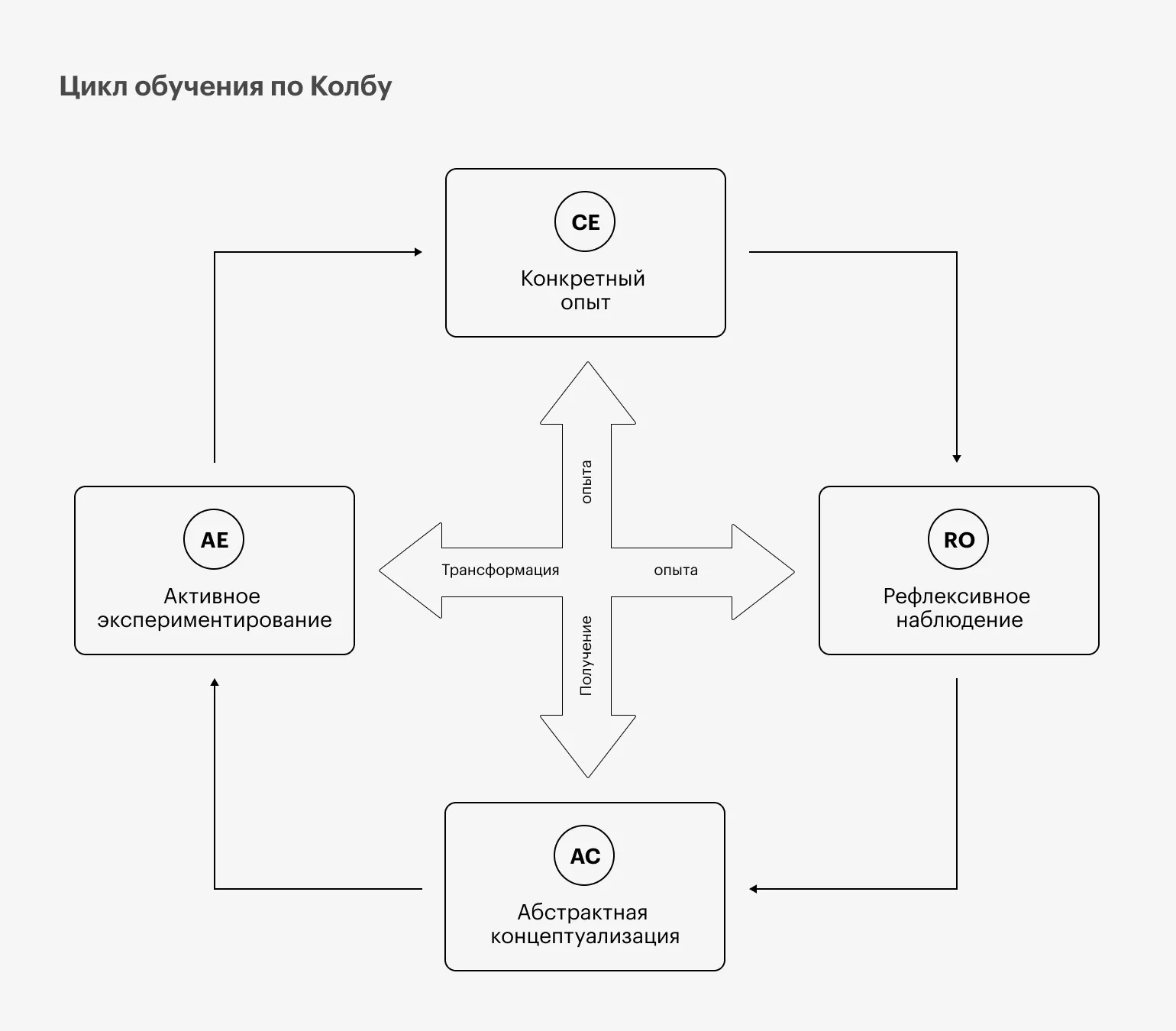
Concrete experience (CE) is a situation when a person needs to perform a certain action, which allows him to gain new experience. This could be either completing a completely new task or repeating a familiar action with a new approach. During a specific experience, a person may notice or sense something that hadn't previously attracted their attention, which contributes to their personal and professional development. Gaining specific experience is important for developing skills and expanding horizons, which in turn affects quality of life and work efficiency.
A sales trainee tries to help a customer in a store to facilitate the purchasing process, but the customer refuses and leaves the store.
A housewife noticed that the leaves of her ficus have turned yellow and are starting to dry out. This could be a sign of various problems, such as improper watering, insufficient light, or pests. To restore the plant's health, it is important to determine the cause of the yellowing leaves. It is necessary to pay attention to the growing conditions of the ficus: optimal lighting levels, watering regime, and soil quality. Regular care and attention to the plant will help avoid similar problems in the future and ensure its beautiful and healthy appearance.
Reflective observation (RO) is a process of understanding personal experience that involves analyzing one's emotions, feelings, and thoughts. This method allows one to identify strengths and weaknesses, contributing to the formation of subjective knowledge. Reflective observation promotes deep self-knowledge and the development of critical thinking, making it an important tool for personal and professional growth. Using RO not only helps one better understand one's reactions to various situations but also improves self-regulation and decision-making skills.
The intern analyzes the situation with the mentor, focusing on the strengths and weaknesses of their interaction with the client. As a result of the discussion, they form conclusions that will help improve their communication skills and enhance customer service.
A housewife is disappointed that her favorite flower died and is eager to find ways to improve this situation. She wants to restore the beauty of her home space and care for the plants so that they please the eye. By using proper care methods and choosing the right growing conditions, she hopes to restore her plant's life and avoid similar problems in the future.
Abstract conceptualization (AC) is a process of reflection that generates new ideas and conclusions, as well as the creation of abstract concepts and generalizations. This process plays a key role in the development of thinking, allowing a person to go beyond specific facts and form broader understandings of the world. Abstract conceptualization fosters creativity and deep analysis, making it an important tool in teaching and research.
The mentor teaches the trainee sales techniques and customer interaction standards and recommends useful literature on the topic. As a result, the new sales professional learns new approaches, theories, and frameworks, which contributes to their professional development and increased work efficiency.
A housewife actively studies various topical blogs and consults with professional florists to gather information and formulate several hypotheses on how to revitalize her ficus tree.
Active experimentation (AE) is the process of applying new knowledge in practice. This involves testing and using abstract concepts that the learner has previously formed. Through active experimentation, the learner gains the opportunity to understand how these concepts function in real-world settings. This approach promotes deeper learning and develops the skills necessary to successfully apply theory in practice. Active experimentation plays a key role in the educational process, allowing students not only to consolidate knowledge but also to develop critical thinking and problem-solving skills.
A trainee interacts with customers and applies various sales techniques learned from her mentor.
A housewife conducts experiments, testing her hypotheses about growing plants. She fertilizes the soil in a flowerpot and moves a ficus to a sunnier location to assess the effect on its growth and health. This approach helps her better understand the plants' needs and improve their thriving conditions.
The literature on the experience-based learning model often states that all four stages must be completed sequentially, beginning with concrete experience (CE) and ending with active experimentation (AE). However, David Kolb's original work does not specify such a mandatory sequence. He emphasizes that the learning cycle can begin with any of the phases, allowing for flexible adaptation of the learning process depending on needs and context. This opens up opportunities for a more personalized approach to training, where the emphasis can be placed on the stage most relevant to the trainee.
In our first example with a novice salesperson, an alternative cycle could be represented as follows:
Abstract conceptualization (AC) is a key stage in the training of trainees, where they are introduced to the main sales techniques used in the company. During the introductory briefing, trainees gain basic knowledge of customer interaction methods, the development of persuasion skills, and effective communication. These skills are the foundation for a successful career in sales and help trainees adapt to the corporate culture. Correct understanding and application of these techniques contributes to improved performance and strengthening the company's position in the market.
Active experimentation (AE) is the process during which the trainee applies a specific sales technique on their first work shift. They strive to follow all the stages of the established algorithm, which allows them to gain practical experience and improve their sales skills. This approach fosters a deeper understanding of the technique and helps the trainee adapt to real-world work conditions.
Concrete experience (CE) shows that website visitors make different purchasing decisions throughout the day: some make purchases, while others abandon them. By analyzing user behavior, it is possible to identify the factors influencing decision-making. Understanding these factors allows you to optimize the sales process and increase conversion, which, in turn, contributes to improved business results.
Reflective observation (RO) is an important training stage during which the trainee analyzes their workday in a discussion with a mentor. During the discussion, the trainee evaluates how successfully they applied specific sales techniques when interacting with each client. Also important is awareness of their own feelings and emotions that arose during the work. This allows not only to understand the effectiveness of the methods used but also to identify areas for further improvement. Reflective observation promotes the trainee's professional growth, helping develop communication skills and adapt to various sales situations.
The core idea of Kolb's theory is that successful completion of each stage of the learning cycle is only possible if the objectives of the previous stage are achieved. However, this does not always occur, as the natural conditions for this may not be created, and the exercises and activities proposed by training developers are not always effective. Therefore, it is important to understand how to optimize the learning process to ensure full completion of all stages of the cycle and achieve maximum results.
If the training is unsuccessful, methodologists note that the "cycle has not turned," indicating a lack of concrete experience, as well as insufficient reflection or mastery of new abstract concepts. If the stage's objectives are successfully achieved, they claim that the "cycle has turned," indicating that the process of gaining or transforming experience has indeed occurred. It is important to understand that successful completion of the learning cycle promotes deeper assimilation of the material and the formation of the necessary skills for further development.
Why the Kolb Cycle is not a magic pill
The Kolb concept is currently actively supported by the educational community as one of the key models for organizing adult learning. However, this does not mean that any training can be easily designed according to the Kolb cycle and thereby guarantee the achievement of learning goals. Effective use of this model requires a deep understanding of its principles and adaptation to specific learning conditions. It is important to consider that successful learning depends on many factors, including participant motivation, context, and teaching methods.
Elena Tikhomirova, founder and CEO of the eLearning center, emphasizes that the Kolb cycle is only one tool for curriculum design. She notes that the use of this cycle is not always justified. Elena believes that the Kolb cycle can be effective in certain situations, but successful training is possible without it. It is important to focus on a preliminary training needs analysis, which allows us to create high-quality educational programs that meet the requirements and expectations of learners.
When designing training, the key moment is the initial stage, during which we analyze the task. Based on this analysis, we can determine whether full training using the Kolb model is required or whether a simple reminder for employees as part of corporate training will suffice. It is important to understand that there are no universal tools that are suitable for all situations and conditions. Each project requires an individual approach to effectively solve the assigned tasks.
There are four situations in which using the Kolb cycle is inappropriate. These barriers can hinder the effective use of the method. Understanding these limitations will help you avoid unnecessary effort and focus on more appropriate approaches to training and development.
Is direct experience necessary for learning, and how critical is it? This question cannot be answered definitively. In some cases, designing training based on the Kolb cycle model may be inappropriate, as direct experience can negatively impact students. It is important to consider the context and specifics of the training to ensure maximum effectiveness. Elena Tikhomirova emphasizes the importance of a sequential approach to training complex professions. A nuclear power plant operator cannot be sent to work without prior theoretical training, just as a doctor cannot be allowed to perform surgery without the necessary knowledge and skills. First, mastery of the theoretical foundations is required, then practice in a safe environment, and finally, work under the supervision of experienced specialists. Only then can one move on to independent work, as is the case with the Kolb cycle. This approach ensures safety and effectiveness in training professionals in high-risk fields. Sergey Zhdanov emphasizes the importance of educational popular science courses and lectures on art. In the context of such training, using the Kolb cycle may be redundant, since the main goal is to convey new information to students, broaden their horizons, and stimulate interest in art. These courses are designed to deepen knowledge and develop an understanding of current issues in the arts, making them a valuable resource for anyone seeking to develop their knowledge.
Sergey notes that this concept is difficult to integrate into transformational programs aimed at changing students' values.

Reading is an integral part of our daily experience and a source of knowledge. It enriches our inner world, develops our thinking, and expands our horizons. Immersing ourselves in books, articles, and other forms of text allows us to better understand the world around us and strengthens our critical analysis skills. In today's world, where information is available in unlimited quantities, it is important to choose quality sources and devote time to meaningful reading. This will help not only in personal growth but also in professional work. Focus on a variety of genres and topics to find what is interesting and useful for you. Read regularly and develop along with the texts.
The Dale pyramid states that learning through practice is more effective than theoretical knowledge. According to this model, levels of information absorption vary: for example, people remember only 10% of a text they read, 20% of what they heard in a lecture, but 75% of information obtained through practical experience. This emphasizes the importance of active engagement in learning, where interaction and practice foster a deeper understanding of the material. Modern educational approaches based on this theory emphasize practical assignments, projects, and interactive teaching methods. Thus, it can be argued that practice truly plays a key role in the effective acquisition of knowledge and skills. Experience-based learning is an effective learning model for adults. Unlike children, who gradually develop the ability to grasp abstract concepts and reflect, adults already have life experience that can be used in the educational process. This methodology emphasizes the practical application of knowledge and skills, which promotes a deeper understanding of the material and its integration into everyday life. Experience-based learning also stimulates critical thinking and independence, making it particularly useful in the modern educational context. Elena Tikhomirova warns of the risks of using the Kolb cycle even for adult students with unstable emotional states. In corporate practice, the need to train employees often arises, but they may not be ready for training due to fatigue, overload, or stress related to the company's situation. In such cases, forcing the employee into new experiences or deep reflection should be avoided, as this can negatively impact the effectiveness of the training. Given employees' emotional state, it is important to approach training with care and flexibility to ensure positive results.
Sergey Zhdanov emphasizes that Kolb's concept dates back to the last century. The first version of the model was developed in the 1980s, and its analysis is based on research conducted in the early 20th century. As a result, this concept fails to take into account many modern contexts, tasks, and tools. This applies both to the current state of neuroscience and to issues related to the integration of smartphones into everyday life. It is necessary to consider how these technologies influence basic learning cycles, as well as the new opportunities and challenges they create for the educational process.
The Kolb cycle lacks built-in tools for goal setting and integration with other learning design models, notes Sergey Zhdanov. When developing curricula based on the Kolb cycle, it is necessary to consider how to link it to the educational strategy, expected outcomes, and prerequisites. There are no ready-made solutions in this matter. However, it is precisely these connections that ensure the effective functioning of the Kolb cycle, making it more effective in the educational process.
Methodologists who deeply study experiential learning sooner or later face important questions. How to integrate the Kolb cycle with Bloom's taxonomy? How to verify that the selected curriculum elements actually contribute to the achievement of goals at each stage of the cycle? How to link the Kolb cycle with outcome-oriented learning design? These questions require attention, as the correct integration of teaching and assessment methods can significantly improve the effectiveness of the educational process. By analyzing approaches and methodological tools, we can create a more holistic and effective educational environment that promotes the deep acquisition of knowledge and skills.
It is impossible to give unambiguous answers to all these questions. The Kolb cycle is not simply four sequential stages with a set of exercises for each of them. The correct combination of these stages cannot guarantee the success of learning. Unfortunately, universal and comprehensive models that provide guaranteed results do not exist. Effective learning requires flexibility and adaptation to the specific conditions and needs of learners.
The Kolb cycle is known to many only through its popular four-stage framework, which is easily found online. However, many do not realize that this framework has a significant theoretical basis, and the cycle itself is only part of a larger systemic model. When looking at the framework, many perceive the Kolb cycle as a simple instruction or a universal standard that can be easily applied in practice. Importantly, the use of such standardized rules and basic frameworks appeals not only to methodologists but also to professionals from various fields. Understanding the deep structure of the Kolb cycle allows for its more effective application in training and development, achieving higher-quality results.
The secret to the Kolb cycle's popularity among methodologists lies in its effectiveness, according to Elena Tikhomirova. However, she emphasizes that implementing this approach in practice is much more difficult than it seems at first glance.
Sergey Zhdanov emphasizes the importance of a deep understanding of Kolb's ideas and cautions against oversimplifying them. He draws attention to the fact that each stage of the cycle described by the author contains many meanings and details, and also defines the boundaries of the theory's application. Kolb's works are written in complex scientific language and are not translated into Russian, which makes them difficult to fully understand. The widely used scheme is only a superficial representation of a deep concept and is often incorrectly interpreted and applied. A proper understanding of Kolb's theory requires a careful study of the original texts and an awareness of their complexity.
5 Typical Mistakes in Understanding and Applying the Kolb Cycle
A typical simplification-misconception is due to the fact that many believe that the stages of the Kolb cycle must be completed strictly sequentially, starting with Concrete Experience (CE) and ending with Abstract Conceptualization (AE). However, it is important to remember that the model also includes learning styles that can significantly influence the student learning process at each stage. Let's look at common mistakes that often occur when designing educational programs using the Kolb cycle.
Pavel Bezyaev, leader and co-founder of the Digital Learning community, emphasizes that it is not always necessary to use all four stages of the Kolb cycle when designing courses. If a learner already has motivation and a clear understanding of the problem they want to solve by the time the course begins, the stages of concrete experience and reflective observation may be redundant, as they have already completed them independently. However, developers often overcomplicate the content and teaching methods by putting students through all four phases of the cycle without considering the feasibility of this approach. It is important to consciously select stages that match the needs and readiness of participants, which will make learning more effective and focused.
A student seeking to acquire information is faced with having to navigate through numerous unnecessary stages. As Pavel notes, as a result of this process, the learner becomes involved in mindlessly repeating the methodology without understanding its true essence. This only leads to irritation and loss of interest in learning. It's important to optimize the learning process to make it more effective and accessible for students, minimizing unnecessary steps and focusing on the essence of the material. Sergey Zhdanov emphasizes the importance of the principle of continuous connection between the learning process and experience in Kolb's model. Some stages of the Kolb cycle, such as active experimentation, can occur outside the educational environment. In such situations, according to Sergey, it is important to provide students with tools for self-assessment and recording their observations, which facilitates a deeper understanding and integration of acquired knowledge. This improves the learning process and makes it more effective, and also develops students' reflective skills. Elena Tikhomirova emphasizes that creating learning experiences and designing reflection for adults is a complex task. The expert cites 3D simulators in games about survival in extreme conditions as an example, expressing doubt that tasks such as "pack emergency supplies into a 3D basket" can provide students with a realistic and useful experience. Tikhomirova emphasizes the importance of high-quality training, which should consider not only theoretical knowledge but also the practical skills needed to solve real-world problems.
Sergey Zhdanov agrees with this idea and argues that the Kolb cycle may "not rotate" for similar reasons.
Experience should not be confused with actions, impressions, or educational outcomes. It is an entirely different category, requiring a deep understanding of the essence of the target activity. Designing in this area becomes a complex task, since it is necessary to consider not only the structure but also the context in which the activity takes place. Understanding these nuances is key to successfully creating effective projects and solutions.
Sergey Zhdanov emphasizes the importance of considering the specifics of applying the Kolb cycle in courses containing complex educational material for groups with different knowledge levels. Participants in such courses go through the stages of the cycle individually, rather than simultaneously. This is a natural aspect of the Kolb model that is often ignored by educational developers. They may mistakenly believe that there's a single experience that suits all students, or that a single correct conclusion can be reached through reflection. This misunderstanding negatively impacts the quality of learning and student satisfaction. Properly understanding and integrating individual learning paths into a course will enhance its effectiveness and help each participant achieve better results.
Sergey discusses a common task in corporate training: sales training for experienced professionals. In this case, there's no need to begin with basic concepts, as participants already have significant experience. For effective training, it's advisable to begin by conceptualizing existing experience or using complex examples in practice. This approach will make the learning process more productive and engage students in active discussion.
To conclude our overview of the Kolb cycle, we can highlight the key idea: the model developed by David Kolb appears simple at first glance, but in reality, it is a complex and multifaceted concept that requires a deep understanding.
Learn more about education and current news in our Telegram channel. Subscribe and stay up to date!
Reworking text for SEO requires using keywords and phrases related to the topic, as well as improving the structure for increased readability.
Read also:
Explore other interesting materials to help you deepen your knowledge on this topic. We offer a variety of articles and studies that cover current issues and the latest trends. Discover helpful tips and tricks to help you use information more effectively. Don't miss the opportunity to expand your horizons and gain new ideas that can be useful in your practice.
- How to build a course that will lead a beginner to professional mastery
- What is a Learning Journey Map, how to create and use this tool
- 8 ways to focus on the student when creating curricula
Profession Methodologist from scratch to pro
You will develop skills in developing curricula for online and offline courses. You will master modern teaching practices, structure your experience, and become a more sought-after specialist.
Find out more