
Contents:

Learn: The Profession of a Methodologist from Scratch to PRO
Learn MoreStudents often find themselves in a situation where they try to memorize all the material for the semester the day before an exam. This tactic can lead to a high score, but the information is forgotten almost immediately after the exam. Even if a student quickly absorbs new information, this approach to preparation does not contribute to the formation of long-term knowledge, which is one of the key goals of learning. Effective preparation requires not only memorization but also comprehension of the material, which allows for long-term retention. Why can something quickly memorized be quickly forgotten? And what can be done to ensure long-term retention of information? To answer these questions, it is necessary to understand how our memory functions. Memory is a complex process that involves encoding, storing, and retrieving information. When we try to remember something, our brain processes data and creates neural connections. If information is not used or repeated, these connections weaken, and we forget. To improve long-term retention, it is useful to use various techniques. Regular repetition, associative links, and the use of mnemonics can significantly improve the effectiveness of memorization. In addition, it is important to get enough sleep and reduce stress levels, as these factors directly affect memory.
Thus, understanding the mechanisms of memory and using effective memorization techniques will help you retain information for a long time.
The main stages and conclusions of this article are presented in the paragraphs marked with a light bulb. If you prefer brief information without in-depth explanations, you can skip to the light bulbs.
What is memory
To understand the concept of memory and the mechanisms by which it works, it is necessary to turn to neurobiology. Memory is a complex process that involves storing, processing, and retrieving information. In neurobiology, memory is viewed as the result of the interaction of neurons in the brain. The formation and strengthening of synaptic connections between neurons plays a key role in the formation of memories. Research shows that different types of memory, such as short-term and long-term, activate different areas of the brain. Understanding these processes not only aids in the study of human behavior but also opens new horizons in the treatment of memory disorders. Thus, a thorough understanding of neurobiology allows us to better understand how memory influences our lives and what methods can be used to improve it.
The human brain consists of billions of nerve cells, known as neurons, which form complex networks through long extensions called axons and short extensions called dendrites. Axons transmit information from one neuron to another, while dendrites receive it. The connection between the axon terminal of one neuron and the dendrite of another neuron is called a synapse. These synapses play a key role in the transmission of nerve impulses, enabling complex processes of thought, memory, and learning.
At most synapses, information is transmitted via neurotransmitters—complex organic compounds such as serotonin, dopamine, norepinephrine, and glutamic acid. These neurotransmitters are contained in specialized vesicles. Under certain conditions, the vesicles open, releasing the neurotransmitters into the synaptic cleft—the narrow space between the axon and dendrite. Receptors that sense neurotransmitters are located on the surface of the dendrite, although there are also receptors on the axons. The effective functioning of these molecules and receptors plays a key role in the transmission of nerve impulses and the formation of neural connections, which, in turn, affects human behavior and emotional state.

A signal, or nerve impulse, is transmitted from one neuron to another when enough neurotransmitter has been released into the synaptic cleft for the receptors to detect it. The signal transmission process depends on both the amount of neurotransmitter and the sensitivity of the receptors. Glutamic acid, a neurotransmitter that plays a key role in the formation and strengthening of synaptic connections, is particularly important for memory. Increasing glutamic acid levels improves cognitive function and memory.
Most neurons have several thousand synapses, which are potential pathways for signal transmission. At any given time, only a fraction of these pathways are active, which determines the efficiency and speed of information transmission in the nervous system.
When memorizing new and complex information, such as material for an exam, signals between neurons travel along previously unused pathways. Memories are connections between neurons, making memory a network property of these cells. Therefore, for effective memorization, it is necessary to form new pathways between neurons. This emphasizes the importance of active participation in the learning process to create strong associations and improve memory.
What types of memory are there?
The brain has many mechanisms responsible for the formation of new neural pathways and the memorization of information. Each of these mechanisms has its own data retention time. Neurophysiologist Vyacheslav Dubynin discusses these mechanisms in detail in his lecture "Brain, Memory, and Learning." In this article, we will briefly review the mechanisms activated when learning new material, namely the mechanisms of short-term memory, also called “current memory,” and long-term memory. Understanding these mechanisms will help improve learning and memorization processes.

Read also:
Learning, brain and DNA: the impact of education on human physiological aspects
Education has a significant impact on physiological processes in the body. Research shows that learning not only develops cognitive abilities but also changes the structure of the brain. Learning activates neural connections, which promotes the formation of new synapses. This phenomenon is called neuroplasticity, and it is the basis for improving memory and skills.
Furthermore, learning can influence gene expression. Scientific research demonstrates that educational practices can change the activity of certain genes that are responsible for brain function and neurotransmission. Thus, learning not only builds skills and knowledge but can also have a profound impact on biological processes.
Importantly, different types of learning, whether formal or self-directed, can elicit different physiological responses. For example, active participation in the learning process, the use of critical thinking and creativity can promote the production of neurotrophic factors that support the health of neurons.
Thus, the impact of learning on the brain and DNA is diverse and multifaceted. Understanding these processes opens new horizons for the development of educational methods and contributes to an improvement in quality of life.
At the beginning of our discussion, we examined receptors—structures that capture neurotransmitters and play a key role in signal transmission. One category of such receptors are NMDA receptors, which are sensitive to the neurotransmitter glutamic acid. These receptors have a unique property: they can be blocked by magnesium ions, forming so-called "magnesium plugs." When an NMDA receptor is blocked by magnesium, it loses its ability to capture the neurotransmitter and transmit a signal, resulting in the pathway becoming inactive. This phenomenon is important for understanding processes occurring in neuropsychology and neurophysiology, as it affects synaptic plasticity and learning.
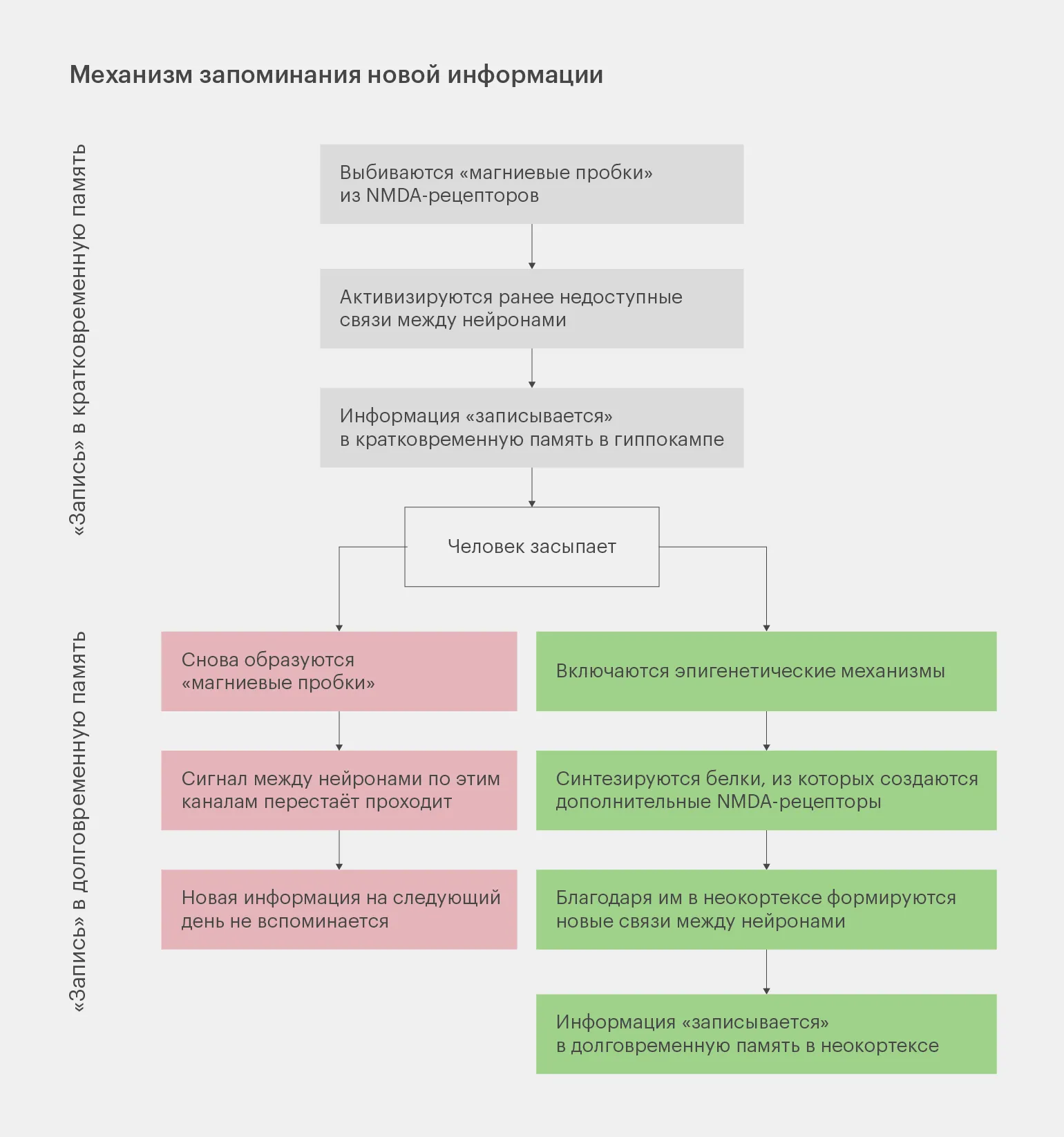
The mechanism of short-term memory, also known as current memory, is based on the process of knocking out "magnesium plugs" from NMDA receptors. This leads to the activation of previously inaccessible channels, allowing us to memorize new information. The importance of NMDA receptors in short-term memory formation underscores their role in neural networks responsible for processing and storing fresh impressions and knowledge. Understanding this mechanism opens new horizons in the study of cognitive processes and may facilitate the development of methods for improving memory.
The process of memorizing information occurs primarily in the hippocampus—a small structure deep in the temporal lobe of the brain responsible for memory formation. However, its capacity for memorization is limited. This can be demonstrated, for example, during a visit to a museum: after several hours of studying the exhibits, attention begins to wander, and perceiving the information becomes significantly more difficult. By the time you return home, you may not remember even half of what you saw. The same principle applies to studying. Trying to study an entire textbook the night before an exam is ineffective, even if the goal is simply to "pass and forget." There is no guarantee that you will be able to recall this information on the exam. Effective memorization takes time and regular repetition to ensure long-term knowledge retention.

At night, when a person is immersed in sleep, the knocked-out "magnesium plugs" return to their places, restoring the blockage of the signal paths.
New information acquired during the day can follow two main paths during sleep. It either disappears from memory or is converted from short-term to long-term. In the latter case, support is provided by other neurobiological mechanisms. This explains why some events remain in memory, while others are quickly forgotten. However, the mechanism by which the brain decides what to record in long-term memory and what to discard as unnecessary remains a mystery. It is impossible to predict which knowledge or impressions will be retained and which the brain will discard. Thus, the process of memorization and forgetting is a complex and not fully understood aspect of human brain function.
A student who stays up all night before an exam and actively memorizes the material can temporarily retain information in short-term memory because the "magnesium plugs" have not yet blocked signal transmission. In other words, the mechanism for forgetting this information is not activated. However, such a preparation strategy may negatively impact their ability to memorize long-term and their overall performance. To achieve the best results, it is important to combine effective study methods with adequate rest and sleep. This will not only help you remember the material but also improve your cognitive function and concentration during exams.
If a student, despite lack of sleep, successfully recalls the information they studied the day before during an exam, this indicates the beginning of the formation of long-term memory. However, this does not guarantee that the new information will remain in the memory for a long time. Long-term memory is a relative concept, as it can retain information for varying periods: from several weeks to many years. Therefore, even if a student performed well on an exam, this does not mean that the knowledge will be retained in their memory for a long time.
The formation of long-term memory is associated with profound changes in the brain that begin with epigenetic mechanisms. Simply put, these mechanisms activate genes responsible for the synthesis of certain proteins. These proteins, in turn, promote the formation of new receptors for glutamic acid. The emergence of additional receptors allows signals to travel through previously non-existent channels, which plays a key role in the process of memorization and information storage.
New connections between neurons are formed in the neocortex, which is the outer layer of the brain's hemispheres. During sleep, the hippocampus plays a key role in the neocortex's learning process, facilitating information retention. This mechanism is important for memory consolidation and acquisition of new knowledge.
The formation of long-term memory occurs Gradually, and it's unlikely that you'll be able to consolidate what you've learned overnight. According to Vyacheslav Dubynin, research shows that material is absorbed more effectively if it's spread out over two days rather than limited to one. This confirms the importance of distributed learning for improving memorization and long-term information retention.
Various factors influence the speed at which stable memories form. One key aspect is prior knowledge. If new information is related to something a person already knows, the process of assimilation occurs significantly faster than when working with completely new information. This highlights the importance of context and associations in the memorization process.

Rework the text without changing its main meaning. Optimize it for SEO and add the necessary information. Avoid using emoticons and unnecessary characters. Don't add sections with numbers or symbols; simply provide plain text.
Read also:
Background plays a key role in remembering new knowledge. The foundations on which we build new understanding are formed by existing knowledge and experience. When we encounter new information, our brain tries to connect it with what we already know. This helps create associations and facilitates the memorization process.
The more knowledge we have in a given area, the easier it is for us to perceive and master new information in that area. For example, if you are learning a new language, your ability to remember vocabulary and grammar will depend on your experience with other languages.
Furthermore, background can influence your level of interest in a new topic. If it is related to something you are already familiar with or interested in, this also contributes to better memorization. Thus, developing and deepening knowledge in various fields not only enriches our background but also improves our ability to learn and memorize new information.
In conclusion, it can be said that having a solid foundation of knowledge significantly simplifies the assimilation of new ideas and concepts, which in turn contributes to effective learning.
The mechanism of short-term memory is carried out by clearing clogged channels, which can soon become blocked again. In contrast, the mechanism of long-term memory is based on improving channel conductivity, which is achieved through the formation of new receptors. The hippocampus is actively involved in the formation of short-term memories, while the work of the neocortex is important for long-term memory.
Quickly forgetting a large amount of material studied for an exam is often due to the brain not having time to commit it to long-term memory. This can occur due to information overload, when the amount of data is too great to memorize in a short period of time. In addition, the complexity of the material also plays a role: if the information is difficult to learn, more conditions are required for its transfer to long-term memory, for example, regular repetition. Effective study methods, such as spaced repetition and the use of associative thinking, can significantly improve memorization and promote deeper knowledge absorption.
What will help you remember what you've studied for a long time
How does our brain decide what to retain and what to forget? Science does not yet provide a definitive answer to this question. However, neuroscientists have identified key principles that help form long-term memories. These principles will be useful for those who strive to remember information for a long time, rather than lose it immediately after the exam. Using repetition, associative thinking, and emotional attachment to the material can significantly improve memorization. It's also important to organize the information logically and structured, which promotes better absorption.
- Steady learning without overload. It's better to study less, but more often, than to study a lot of information at once. Too much information overloads the hippocampus, making it impossible to remember everything at once.
- Repetition. By periodically reviewing the material you've covered and solving problems on it, you help it become embedded in your long-term memory. That is, studying gradually throughout the semester and reviewing periodically is more effective than memorizing everything at once the day before the exam and then not reviewing it.

Study additional materials:
The forgetting curve is a concept that describes how information is forgotten over time. It was first introduced by German psychologist Hermann Ebbinghaus in the late 19th century. According to his research, memory for new material decreases over time if it is not reviewed. This means that most people forget most of the information they have learned within the first few days after learning.
To help students remember information long-term, it is important to employ strategies based on the principles of the forgetting curve. Regularly reviewing learned material and using active memorization methods such as testing and practical application of knowledge significantly improves long-term memory. Creating associations between new information and already known facts also promotes more effective memorization.
Furthermore, it is important to consider individual student characteristics, such as their learning style and motivation level. Using a variety of methods, including visual, auditory, and kinesthetic approaches, helps make the learning process more effective and memorable.
The introduction of technology, such as mobile review apps and online courses, can further support students in the memorization process. These tools provide the opportunity to regularly interact with the material being studied, which promotes its consolidation in memory.
Thus, understanding the forgetting curve and applying appropriate teaching methods can significantly improve the effectiveness of information acquisition by students, allowing them to remember the material for a long time.
- Emotional significance. We better remember emotionally charged events—both happy and sad. Therefore, material will be more reliably retained if it evokes emotions. When studying new topics, it is useful to associate them with something that does not leave you indifferent.
- Absence of distractions. To remember something for a long time, it is important to focus on studying and not be distracted by extraneous activities, such as hanging out on social media and chatting in instant messengers.
- Good brain health. To memorize effectively, the brain must function well. And for this, proper nutrition and quality sleep are very important (it plays a very significant role in the mechanism of long-term memorization).
We express our gratitude to Yulia Marakshina, a researcher at the Federal Scientific Center for Psychological and Interdisciplinary Research, for her expert assistance in preparing this article.
Read also:
- Scientists: Forgetting Can Be a Form of Learning
- How to Prepare for an Exam Using the Feynman Method, or... a Rubber Ducky
- How Alternating Topics Helps You Remember Material for a Long Time
- Researchers Have Named New Ways to Better Memorize Information
The Methodologist profession from scratch to PRO
You will improve your skills in developing curricula for online and offline courses. You will master modern pedagogical practices, structure your experience and become a more sought-after specialist.
Find out more