Free test: which digital profession is right for you? Find out the answer in 15 minutes and try your hand at a new specialty.
Find out moreWhich muscles need to be trained to have beautiful shoulders
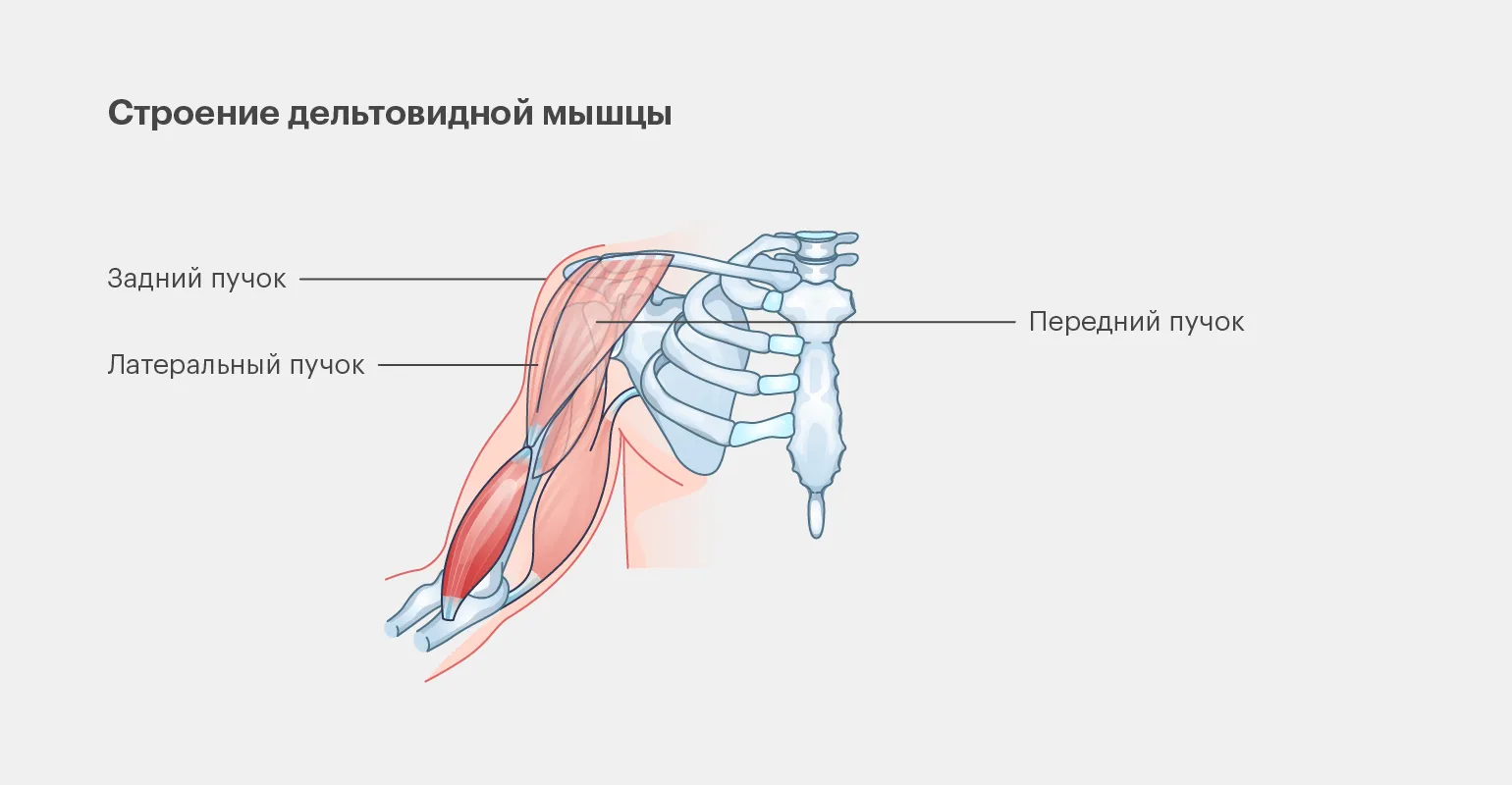
The volume and roundness of the shoulders are formed by training the deltoid muscles. Developed deltoids give the shoulders a wider and more masculine appearance. Regular deltoid exercises not only promote aesthetic transformation but also improve overall fitness. To achieve desired results, it's important to incorporate a variety of exercises that target different parts of the deltoid muscle. The deltoid muscle consists of three main parts: the anterior, middle, and posterior. These three sections work synergistically to provide a wide range of shoulder motion. The anterior part is responsible for raising the arm forward, the middle part is responsible for abduction, and the posterior part is responsible for moving the arm backward. The deltoid muscle plays a key role in athletic and everyday movements, so it's important to train and strengthen it properly. Effective deltoid exercises will help develop strength and endurance, as well as improve overall fitness.
- Anterior - bends the arm and rotates it inward.
- Middle (lateral) - moves the arm away from the body and raises it to a horizontal position.
- Rear - extends the arm and rotates it outward.
The deltoid muscle plays a vital role in athletic performance, participating in straight punches in boxing, chest passes in basketball, and pushing and blocking in rugby. It is also actively involved in tennis, Frisbee throwing, swimming, mixed martial arts, and rowing. Developing the deltoid muscle improves strength and coordination, which is key to success in various sports. Maintaining its tone will help athletes avoid injury and improve training effectiveness.
In addition to the deltoid muscle, which is responsible for arm abduction, other important muscles are also involved in shoulder joint movements. These include the rotators of the shoulder, such as the infraspinatus, supraspinatus, and teres major muscles, which provide rotation and stabilization of the shoulder. The muscles responsible for flexion and extension include the biceps brachii and triceps brachii. These muscles work in tandem to provide a wide range of motion and improve shoulder function. Proper training and strengthening of these muscles can improve mobility and prevent injury.
- Flexors - biceps, coracobrachialis;
- Extensors - triceps, teres minor, and infraspinatus;
- Adductors - pectoralis major, latissimus dorsi, teres major.
- Rotators - subscapularis, infraspinatus, and teres minor.
The shoulder girdle muscles function synchronously to provide a wide range of motion and shoulder joint stability. Their coordinated work plays a key role in maintaining mobility and preventing injury. Strong and flexible shoulder muscles contribute to the effective performance of various physical exercises and activities in everyday life.
Read also:
Effective exercises for triceps: on simulators, with weights and your own weight
Triceps is one of the key muscle groups responsible for the development of strength and shape of the arms. Proper triceps training not only helps improve the appearance of your arms but also enhances overall upper body function. In this article, we'll cover ten effective triceps exercises that can be performed using machines, weights, and bodyweight. Machine exercises allow you to precisely control the load and minimize the risk of injury. They're great for both beginners and experienced athletes. Using free weights, such as dumbbells and barbells, helps activate additional muscle groups, making the workout more comprehensive. Bodyweight exercises are ideal for home use and help develop endurance. Each of the exercises presented can be adapted to any fitness level, making them versatile and accessible. Regular triceps training will help you achieve your desired results and strengthen your arm muscles.
Top 10 Shoulder Exercises
The shoulders, and in particular the deltoids, receive a certain amount of work even without specific exercises. Common activities such as lifting, pushing, pulling, and carrying objects contribute to their development. To enhance your workout and effectively develop the shoulder muscles, we have prepared a set of exercises of varying difficulty. These exercises will help you achieve better results and strengthen your deltoids.
- ⭐️ — Beginner
- ⭐️⭐️ — Intermediate
- ⭐️⭐️⭐️ — Advanced
- ⭐️⭐️⭐️ — High Intensity.
Difficulty Level: Easy
Text:
When you start learning a new topic or skill, it is important to understand that the difficulty level can vary. Content that does not require in-depth knowledge or prior preparation is often available for beginners. A low difficulty level makes the learning process more accessible and understandable. This allows beginners to confidently dive into the material, gradually mastering the basic concepts and skills.
It is important to choose resources that are appropriate for your skill level. Beginner courses and learning materials can help you build a solid foundation to build on as you explore more complex topics. Remember that every step of your learning process is important, and even small achievements contribute to your progress.
The right approach to learning will allow you to easily overcome obstacles and move forward with confidence.
This exercise actively engages the posterior deltoid, trapezius, and small muscles responsible for shoulder rotation. This exercise is excellent for injury prevention and helps improve posture, which is especially important for people with a sedentary lifestyle. Regular training will help strengthen the shoulder girdle and improve shoulder joint stability.
During this exercise, you need to alternately assume poses forming the letters Y, T, W, and L. This workout is especially useful for office workers, allowing you to stretch during breaks between work. In addition, athletes can use the YTWL complex to warm up their muscles before more intense exercise. Regularly performing these exercises helps improve posture, increase flexibility, and strengthen back muscles, which is important for both sedentary work and physical activity.
Technique plays a key role in achieving effective results in any physical activity. Proper technique not only helps avoid injury but also improves the quality of your workout. When performing exercises, it is important to adhere to the basic principles: correct posture, movement control, and synchronized breathing.
Each exercise requires an individual approach, and mastering technique may take time. It is recommended to start with light weights or easier variations to focus on the quality of execution. By gradually increasing the load, you can improve your results and achieve your goals.
It is also important to remember the regularity of your workouts and adjust your program based on your progress. Don't forget about the need to warm up and cool down to prepare your muscles and recover after exercise. Following these recommendations, you will be able to perform the exercises effectively and get the most out of your workouts.
- Stand with your feet shoulder-width apart. Bend your torso forward at a 45° angle, bending at the hips. Keep your back straight and your pelvis back.
- Get into a Y position: raise your straight arms forward and up, forming a "fork" (thumbs pointing to the ceiling).
- Get into a T position: spread your straight arms out to the sides, forming a horizontal line (palms down).
- Get into a W position: bend your elbows at a 90° angle, pressing them to your body. Spread your forearms out to the sides, squeezing your shoulder blades together.
- Get into an L position: from the W position, lower your forearms vertically down, maintaining the angle at the elbows.
To increase the difficulty of the exercise, you can add dumbbells. This will not only increase the load but also help improve muscle strength and endurance. Using dumbbells in your workouts allows you to vary the exercises and engage different muscle groups, which contributes to more effective fitness progress.
Safety precautions are an important aspect of ensuring safety in various situations. They help minimize risks and protect both personal health and property. Above all, you should always be aware of your surroundings and avoid dangerous places and situations. You should use protective equipment when performing potentially risky tasks. It is also important to follow equipment operating instructions and monitor your health. Regular training and awareness of possible hazards will help improve safety. Incorporating safety precautions into your daily practice helps create a safer environment for everyone.
- Take your time—quality is more important than quantity.
- Breathe correctly: exhale on the effort (raising your arms), inhale on the return.
- If you feel pain in your shoulders, decrease the amplitude or skip the L position.
The difficulty level of this exercise is two stars. This rating indicates that the task is of medium difficulty and can be accomplished with some effort. Approach it with attention and patience, and you will successfully achieve your goal. Keep in mind that achieving the result may require both a basic and a more advanced understanding of the topic.
These exercises actively engage the deltoid muscles. These muscles, located in the shoulder area, play a key role in ensuring the mobility and stability of the upper limbs. Working the deltoid muscles helps improve the strength and shape of the shoulder girdle, which is especially important for athletes and fitness enthusiasts. Correctly performing deltoid exercises helps prevent injuries and improve overall fitness.
You will need dumbbells to perform the exercises.
The technique requires consistent and precise execution of the exercises. It is important to pay attention to the correct execution of each operation, which will help avoid mistakes and improve efficiency. Adherence to the technique ensures not only high-quality results but also safety. It is recommended to familiarize yourself with the main steps and nuances in advance to confidently complete the tasks. Proper technique will improve your skills and boost your confidence.
- Stand holding dumbbells with a closed neutral grip—thumbs gripping the handles, palms facing your body.
- Place the dumbbells alongside your thighs, keeping your arms straight or slightly bent at the elbows. To stabilize your body, either stand with one leg in front of you or place your feet slightly wider than hip-width apart.
- Tighten your abdominal muscles to brace your core.
- Draw your shoulder blades down and back, maintaining this position throughout the exercise. Your head should be in line with your spine.
- Exhale and slowly lift the dumbbells up and out to the sides.
- When your arms reach above 60–70 degrees (approaching shoulder level), rotate them slightly outward so that the front edge of the dumbbells is slightly raised.
- Continue lifting the dumbbells until your arms are at shoulder level and approximately parallel to the floor.
- As you inhale, slowly lower the dumbbells back to the starting position, maintaining a slight bend in your elbows and a neutral grip.
Safety precautions are an important aspect of safety in various areas of life. Following these precautions helps minimize risks and prevent accidents. It is important to be alert and aware of potential hazards to ensure your safety and the safety of others. Taking safety precautions includes using protective equipment, following instructions and rules of conduct, and regularly receiving training and information about possible hazards. Effective adherence to safety precautions helps create a safe environment both at work and in everyday life.
- Keep your body upright, do not arch your lower back.
- Maintain a neutral wrist position - avoid flexing or extending them.
Difficulty level: three stars.
This exercise can also be performed with dumbbells, but this version makes it more challenging.
The exercise actively works the anterior deltoids, triceps, and pectoralis major. These muscle groups play a key role in shaping the silhouette of the upper body. The anterior deltoids are responsible for raising the arms, which is important for various sports activities. The triceps, in turn, help extend the elbow and strengthen the upper limbs. The pectoralis major muscles not only provide a powerful appearance, but are also involved in most exercises involving pressing and lifting weights. Regularly training these muscles will help improve overall fitness and increase strength.
Technique plays a key role in achieving effective results. Correctly performing exercises and actions helps avoid injury and improve overall performance. It is important to focus on precision of movement, breathing control, and maintaining proper posture. Regular practice and attention to detail will help you master the skills and improve your fitness level. Remember to warm up before and cool down after your workout to ensure muscle recovery and reduce the risk of injury. Proper technique is the key to success for both beginners and experienced athletes.
- Hold dumbbells in your hands and sit on a bench with back support so that your head, shoulders, and buttocks are in contact with the surface.
- Place your feet firmly on the floor. Engage your core and abdominal muscles to stabilize your body.
- As you exhale, slowly lift the dumbbells to shoulder level with a closed grip—palms facing forward, thumbs clasped around the handles. The dumbbells should be shoulder-width apart or slightly wider, with your wrists in a neutral position (no flexion or extension).
- Draw your shoulder blades down and back—to do this, pull your shoulders down and back—and hold them in this position throughout the exercise.
- As you exhale, lift the dumbbells up until your elbows are fully extended. Try not to arch your lower back.
- As you inhale, slowly lower the dumbbells, bending your elbows, while keeping your core tight and your wrists in a neutral position.
Before starting any activity, it is important to follow safety precautions. This will help avoid unpleasant situations and ensure safety. We recommend that you carefully read the instructions and recommendations before performing any operations. Using protective equipment and following safety rules is the key to successful completion of the task. Remember to keep the work area tidy and avoid distractions to minimize the risk of accidents. By adhering to these simple rules, you can ensure your safety and the safety of others.
- Don't simply let the dumbbells fall under the force of gravity - consciously engage your latissimus dorsi to pull the dumbbells down toward you.
- For safe execution of the exercise, it is important to have a spotter. The person should stand behind you in a stable position, keeping their hands close to your wrists (but not touching) to support the weight if necessary.
Difficulty level: three stars.
The exercises focus on training the triceps and anterior deltoids. These muscle groups play a key role in improving the strength and size of the upper body, promoting the harmonious development of the shoulder girdle and arms. Training the triceps helps increase their endurance and strength, which is important for performing many other exercises. The anterior deltoids, in turn, are responsible for the stability of the shoulder joint and the formation of an aesthetically pleasing shoulder. Regular training of these muscles not only contributes to improved physical fitness but also prevents shoulder injuries.
The exercise looks simple, but to achieve maximum effect, it is necessary to maintain perfect technique. This will ensure a high level of concentration and control over movements. Correct exercise execution plays a key role in their effectiveness, allowing you to avoid injuries and achieve the desired results.
Execution technique is an important aspect in any activity related to physical activity or creativity. Proper technique ensures not only the effectiveness of task performance but also safety. Regardless of whether you are engaged in sports, dance, or art crafts, adherence to execution technique helps to avoid injuries and negative consequences.
To achieve best results, it is necessary to learn the basics of technique and practice regularly. Pay attention to details such as correct posture, weight distribution, and coordination of movements. This will help you develop the necessary skills and improve your level of proficiency in your chosen field.
Remember the importance of warming up before starting your workouts and cooling down after them. This helps improve flexibility and reduce the risk of injury. Constantly analyzing and adjusting your technique will help you reach new heights and significantly improve your results.
- Lie on the floor face down. Place your palms shoulder-width apart, fingers pointing forward. Keep your feet together, forming a straight line from your head to your heels. Keep your elbows close to your body (the angle between your body and forearms is 45°).
- As you inhale, slowly bend your elbows, lowering your chest toward the floor. Touching your chest to the floor will ensure full range of motion.
- As you exhale, powerfully push your body upward, maintaining a straight line.
Safety precautions are an important aspect of safety in various areas of life. They help prevent risks and minimize possible negative consequences. When working with hazardous substances or in high-risk environments, certain rules must be followed. Be sure to use personal protective equipment, such as gloves and masks, to ensure your safety. It is also important to monitor the environment and avoid potentially dangerous situations. Don't forget about regular training and refresher courses to be prepared for any unexpected situations. Following these safety precautions will help protect the health and life of both you and others.
Keep your eyes looking down and don't tilt your head back. This will help prevent excessive arching in the lower back and maintain proper posture.
- Lumbar arch - engage your glutes and abs to maintain a straight line.
- Partial range of motion - lower yourself until your chest touches the floor.
- Elbow flare - keep your elbows close to your body to emphasize the triceps.
This exercise is rated at two stars.
This exercise actively works the triceps, front deltoids, and pectoralis major. These muscle groups play a key role in shaping the upper body, contributing to the development of strength and endurance. Regular training with an emphasis on these muscles will help improve your overall fitness and appearance.
This exercise is ideal for those looking to strengthen their shoulders without the use of equipment. It can be performed at home, but it is important to ensure a secure support. It is recommended to use sturdy and stable chairs or benches for safe execution.
Technique is a key aspect that determines the effectiveness and efficiency of any task or exercise. Correct technique not only helps achieve your goals but also reduces the risk of injury. It is important to consider the basic principles: maintaining correct posture, controlling your movements and breathing. These elements will help improve overall performance and ensure safety. It is also worth regularly analyzing and adjusting your technique to achieve maximum results. Pay attention to details, because they can significantly affect the final result.
- Place two chairs (or benches) parallel to each other, 50-70 cm apart. Sit between them, resting your palms on the edges of the chairs, fingers pointing forward.
- Straighten your legs and place your heels on a third chair (or bench) in front of you. Your body should form a straight line from your shoulders to your heels.
- As you inhale, slowly bend your elbows, lowering your body down. Stop when your shoulders are parallel to the floor (don't go any lower!).
- As you exhale, powerfully push your body upward, straightening your arms completely.
Precautions are an important aspect of ensuring safety and health in various situations. Following basic precautionary principles helps minimize risks and prevent accidents. When working with potentially hazardous substances, in high-risk environments, or in crisis situations, it is essential to follow established instructions and recommendations. It is important to use appropriate personal protective equipment, such as gloves, masks, and safety glasses. It is also important to regularly receive training and increase your awareness of potential risks to be prepared for various scenarios. Remember the importance of informing others about precautionary measures and cooperating in following safety rules. Following these guidelines will help create a safe environment for everyone.
- To make it easier, bend your knees and place your feet flat on the floor—this will reduce the strain.
- Avoid jerking or swinging—keep your movements smooth.
- If you feel pain in your shoulders, decrease the range of motion or replace the exercise with a close-grip bench press.
The difficulty level of this exercise is rated as high. It requires significant effort and a deep understanding of the subject. To complete it successfully, you must consider all aspects and thoroughly analyze the information. Approach the task with utmost seriousness, as the end result depends on it. A high level of difficulty requires certain skills and experience, which is an important condition for success.
When performing the exercises, the emphasis is on working the anterior deltoids, triceps, pectoralis major, as well as the latissimus dorsi and rhomboid muscles of the back. These muscle groups play a key role in shaping the upper body, contributing to improved strength and endurance. Regularly training these muscles will help not only achieve aesthetic goals but also improve overall fitness.
This intense exercise combines strength, explosive power, and coordination, making it ideal for experienced athletes looking to improve their upper body and master workout elements. If you can perform more than 15 pull-ups or basic push-ups, this exercise will be a great addition to your training program. It not only increases physical strength but also develops coordination skills, which is essential for achieving high fitness results.
To perform the exercises, you will need a pull-up bar, which is a standard-thickness crossbar.
The technique involves a number of important steps that must be taken into account to achieve the best results. First of all, you should properly prepare your work area and the necessary tools. Pay attention to the quality of the materials, as this directly affects the final result.
Next, it is important to follow the established sequence of actions, avoiding deviations from the recommended methods. This will ensure not only the effectiveness of the process, but also the safety of the work.
Remember to take regular breaks to avoid fatigue and reduce the risk of errors. It is also useful to record your results, which will allow you to analyze and improve your technique in the future.
By following these recommendations, you can significantly improve the quality of your work and achieve your goals.
- Stand under the pull-up bar (horizontal bar), feet shoulder-width apart.
- Jump up slightly, grab the bar with an overhand grip - palms facing away from you, slightly wider than shoulder-width apart.
- Continue the movement, and quickly pull yourself up. Use the momentum of the jump to do this.
- At the top of the lift, throw your body over the bar, straightening your arms, and rest them on the bar.
- Slowly lower yourself down, controlling the movement: first bend your arms at the elbows, then smoothly return to the hang.
Before working with any tools or materials, it's important to follow safety precautions. This will help prevent injuries and accidents. Always use protective equipment, such as gloves and goggles, to protect your skin and eyes from potential damage. Before starting work, read the instructions and recommendations for safe use of the equipment. Ensure the work area is well-lit and clear of clutter to minimize the risk of tripping or injury. Remember to use proper technique when performing tasks to reduce the risk of injury. Following these simple rules will significantly improve the safety and effectiveness of your work.
- The movements should be smooth and continuous: jump → pull-up → push-up → lower back down.
- At the initial stage, use inertia, but over time, try to reduce its role to increase the load.
Difficulty level: three stars.
During the exercise, the main load is directed at the pectoralis major muscles, triceps, and deltoids. Additionally, the abdominal, back, and thigh muscles are actively engaged during the workout. This complex effect contributes not only to the development of strength and endurance, but also to the formation of a harmonious figure.
Synchronized walking "crocodile" is one of the most popular exercises in China. This advanced calisthenics exercise, which involves using your own body weight for training. The complexity of this exercise lies in the coordination and body control required, which requires a high level of physical fitness and concentration. The "Crocodile" not only develops strength and endurance but also improves flexibility, making it an effective tool for a comprehensive workout.
This exercise requires high physical endurance, as the arms and core are constantly under load. It is also important to develop coordination, especially when twisting the core. This exercise requires hip flexibility, which allows for proper leg bending and effective knee-to-elbow contact. Regular training will help improve these skills and strengthen the muscles, which in turn will improve overall physical fitness.
Technique is key to achieving high results in any activity. Correct execution of tasks not only improves the quality of work but also reduces the risk of errors. To effectively perform the technique, it is important to follow clear instructions and take into account individual characteristics and conditions. Attention to detail, adherence to the sequence of actions, and regular practice contribute to skill improvement. It is also important to analyze the completed work to identify possible errors and ways to correct them. By paying attention to technique, you can significantly improve your productivity and the quality of your work.
- Get into a push-up position: palms on the floor shoulder-width apart, feet on your toes. Maintain a neutral head and neck position (your gaze should be directed downwards).
- Lower your body closer to the floor, as if doing a push-up.
- Begin to "crawl" forward, alternating your right arm with your left leg and your left arm with your right leg. Your bent knee should touch your elbow on the same side.
- After completing the distance forward, repeat the same movements in the opposite direction.
Safety precautions play an important role in maintaining safety and security. Following safety recommendations helps prevent accidents and minimize risks. It is important to always be aware of your surroundings, obey established rules, and use protective equipment when necessary. Don't forget about the need for regular training and raising awareness of potential hazards. This will help you and your loved ones stay safe in a variety of situations. By staying alert and taking reasonable precautions, you can avoid dangers and ensure your protection.
- Control your speed - performing slowly improves stability and coordination.
- If you feel discomfort in your shoulders or lower back, reduce the range of motion.
Difficulty level: moderate
This text will help you understand the main aspects of the topic. We will cover key points that will help you better navigate this area. The focus will be on the essential points, without unnecessary information. The text is optimized for search engines to make it easier to find and understand.
If you have any questions or need additional information, we are ready to help. We strive to provide high-quality content that meets your expectations and needs.
The posterior deltoid plays a key role in the development of the shoulder girdle and upper back. This muscle is responsible for shoulder abduction and rotation, as well as stabilization of the shoulder joint. Working the posterior deltoid helps improve posture and prevent injury, especially in people who engage in strength training or sports that require active arm movement. Exercises aimed at activating the posterior deltoid contribute to increased muscle mass and overall upper body strength. Incorporating these exercises into your training program will help achieve harmonious muscle development and improve functional performance.
This exercise is a great alternative to classic pull-ups, especially if you don't have access to a bar. Instead, you can use a table to perform this exercise.
The execution technique includes a series of sequential actions that must be carried out with high precision and attention to detail. At the first stage, it is important to properly prepare the workplace and the necessary tools. After this, you should carefully read the instructions or recommendations to avoid possible errors.
When performing the technique, it is necessary to follow the correct sequence of actions, which will significantly increase the efficiency and quality of the result. It is also important to monitor each stage of the process in order to promptly identify and correct possible deficiencies.
It is necessary to take into account individual characteristics and level of training, which will allow you to adapt the execution process to specific conditions. Regular practice and analysis of your actions will help improve your skills and achieve high results.
In conclusion, the correct execution technique not only ensures high-quality results, but also contributes to the development of professional skills, which can subsequently have a positive impact on your career.
- Lie on your back under a stable table (or between two chairs with a cane). Bend your knees at an angle of 90-135°, rest your heels on the floor.
- Grab the edges of the table/stick with your hands wider than your shoulders (overhand grip).
- As you exhale, pull your chest toward the edge of the table, bringing your shoulder blades together. Your elbows should move along your body, not diverge to the sides.
- As you inhale, slowly lower your body, almost touching the floor with your shoulder blades.
Precautions play a key role in ensuring safety and health. Following basic rules can significantly reduce risks and prevent unwanted consequences. It is important to always be mindful of your surroundings and ensure that all necessary instructions are followed. The use of personal protective equipment, such as gloves and masks, is especially important in situations with potential danger. You should also avoid contact with potentially hazardous substances and follow storage and disposal rules. Regularly checking equipment and following operating instructions will help prevent accidents. By following these recommendations, you can ensure a safe environment for both yourself and those around you.
For increased comfort during exercise, we recommend using a soft mat behind your back. This provides support and helps prevent discomfort, which promotes more effective training and relaxation. Choosing the right mat can also improve your posture and reduce the risk of injury.
- Choose a sturdy support—a table or stick should be able to support your weight.
- If you feel pain in your shoulders, decrease the range of motion or decrease the angle.
Difficulty level: low.
This workout actively works the anterior and middle deltoids, trapezius, and pectoralis major. These muscle groups play a key role in shaping the shoulder girdle and upper body. Strengthening the deltoids improves posture and increases functional strength, which is especially important for athletes and people involved in physical activity. Training the trapezius helps develop strength and endurance, which also has a positive effect on overall fitness. The pectoralis major, in turn, provides a powerful push in various sports. Regularly training these muscles not only improves your appearance but also promotes overall physical harmony.
This exercise can be performed in the gym using a crossover—a piece of strength equipment with cables. The crossover allows you to effectively work various muscle groups, improving strength and flexibility. This equipment is ideal for performing a variety of exercises, making it a versatile training tool.
Proper technique for performing a task requires precise adherence to established instructions and methods. It is important to consider all stages of the work to achieve the desired result. Start by preparing the necessary equipment and materials, making sure all tools are in good working order.
Then move on to planning the process. Develop a clear algorithm of actions that will help avoid mistakes and increase the efficiency of the task. Pay attention to details, as even small omissions can affect the end result.
After this, begin performing the task itself. Work carefully and focused, following the pre-defined plan. As you perform the exercise, try to regularly check your intermediate results and adjust your actions if necessary.
After completing the exercise, analyze the results. Assess how successfully the task was completed and identify potential areas for improvement. This will allow you to improve the quality of similar tasks in the future. By following this technique, you can significantly improve your skills and achieve better results in any activity.
- Set the cable crossover block to the lowest level.
- Stand with your back to the machine, grab the cable handle or "pigtail" so that it is in front of your hips, and the cable itself is between your legs.
- Slightly bend your elbows and lift the handle up to shoulder level.
- Hold at the top for a couple of seconds.
- Slowly lower the handle to the starting position.
Precautions are an important part of staying safe in various situations. Following these recommendations helps minimize risks and protect your health. Above all, always be aware of your surroundings and be alert to potential threats. Use protective equipment, such as masks and gloves, when necessary. Wash your hands regularly with soap or use antiseptics to prevent the spread of infections. Keep necessary medications and first aid supplies accessible. Familiarize yourself with the basic rules of behavior in emergency situations so you are ready to respond quickly. By following these simple precautions, you can significantly increase your safety and protect the health of others.
- Avoid using too much weight to avoid overstraining your shoulder joints.
- Avoid jerking and sudden movements; The movement should be smooth and controlled.
Difficulty level: medium.
This dynamic exercise combines the static load of the plank with stretching and strengthening of the shoulder girdle. It is ideal for improving core strength, flexibility, and body control. The exercise helps strengthen major muscle groups and develop overall physical endurance, making it an excellent choice for training. Regularly performing this complex will help improve posture and prevent injuries, as well as increase your physical fitness.
The technique of execution involves strict adherence to established methods and processes to achieve the desired result. It is important to consider the correct sequence of actions to minimize errors and increase efficiency. When performing any task, you should pay attention to detail and control each stage of the work. This will not only help complete the project successfully but also improve the quality of the final product. Correct technique helps develop skills and improve professionalism.
- Lie on your stomach, place your palms under your shoulders, and straighten your legs.
- As you inhale, lift your hips off the floor, pushing your body upward, and open your chest.
- Stretch your arms, engaging the muscles of your back and arms.
- Look up or forward. This position is called "upward-facing dog."
- As you exhale, draw in your stomach and roll over the balls of your feet (lift them and turn them over onto the balls of your feet). At the same time, lift your pelvis up and back, lengthening your spine.
- Lower your heels toward the floor if flexibility allows (you can leave them slightly above the ground).
- Straighten your arms and legs, forming a V-shape with your body. Your back, neck, shoulders, and arms should remain in a straight line. This position is called "downward-facing dog." From there, return to the upward-facing dog position and back again.
It is important to take safety precautions before using any service or product. This will help avoid potential risks and negative consequences. Before making a decision, carefully review all available information. Make sure you understand all aspects related to use and read reviews from other users. In addition, follow current recommendations and safety standards to minimize the possibility of unpleasant situations. Be mindful of your health and safety, and consider the advice of experts in this field.
- Avoid rounding your back or lowering your chest to the floor.
- If you have injured wrists, it is better to avoid this exercise.
Some people believe that there is no single ideal exercise for training shoulders, notes John P. Porcari, chair of the department of clinical exercise physiology at the university. The shoulder joint has complex anatomy, and to activate all three deltoid muscle bundles with maximum effectiveness, exercise variety is required. This means that to fully train your shoulders, you need to incorporate a variety of movements and approaches into your program. Alternating exercises will help develop strength and stability in the shoulder girdle, as well as prevent possible injuries.
Free test: which digital profession is right for you?
IT, design, marketing or management? Find out the answer in 15 minutes. And then try your hand at a new specialty for free.
Find out more