
Contents:
- Abraham Maslow: The Founder of Humanistic Psychology and His Contribution to the Understanding of Human Needs
- Maslow's Hierarchy of Needs: The Key to Understanding Human Motivation
- The Structure of the Levels of Maslow's Hierarchy of Needs
- The Possibility of Moving Through the Levels of Maslow's Hierarchy
- The Relevance of Maslow's Theory in Modern Management
- Application of Maslow's Hierarchy in Marketing: Strategies and Examples
- How Maslow's Hierarchy Helps Motivate Employees
- Maslow's Hierarchy of Needs: Key Aspects

Internet Marketer: 5 Steps to a Successful Profession
Learn MoreAbraham Maslow: The Founder of Humanistic Psychology and His Contribution to the Understanding of Human Needs
Abraham Maslow is a renowned American psychologist who significantly influenced humanistic psychology in the mid-20th century. His research and theories became a cornerstone in understanding human nature and motivation. Maslow emphasized the importance of the individuality of each person, which contributed to the development of new approaches in psychology and related fields. His concept of a hierarchy of needs remains relevant and widely used in psychology, management, and education, helping to explain how different needs influence human behavior and self-development.
During his career, Abraham Maslow conducted extensive research on human behavior and identified universal needs that can be organized into a hierarchical structure. This approach became the basis for his seminal work, "A Theory of Human Motivation," published in 1943. In it, Maslow describes how different levels of needs, ranging from basic physiological needs to higher social and self-actualizing needs, influence human motivation. Understanding this hierarchy allows for a better understanding of the factors that shape people's behavior and aspirations.
Interestingly, Abraham Maslow did not use traditional research methods or surveys to support his theory. His conclusions were based on a careful analysis of the biographies of prominent figures such as Thomas Jefferson, Abraham Lincoln, Aldous Huxley, and Albert Einstein. Maslow noticed that these key figures went through similar stages on the path to self-actualization, which led him to formulate the concept of a hierarchy of needs. This approach became the basis for further research in the fields of psychology and personal growth, opening new horizons for understanding human motivation and self-actualization. Abraham Maslow developed the theory of the hierarchy of needs, which identifies several levels, starting with basic physiological needs and ending with the need for self-actualization. He argues that to achieve higher levels of satisfaction, it is necessary to sequentially satisfy lower needs. This sequence is the basis of his theory, emphasizing the importance of satisfying basic needs for further growth and development of the individual. Maslow's approach to needs is an important aspect in psychology and sociology and also finds application in various fields, including human resources management and education. Maslow's theory continues to be relevant and is widely used in various fields, including psychology and business. It provides valuable insight into how need satisfaction influences people's motivation and behavior. This makes the theory an important tool for professionals in the fields of management, coaching, and education. Understanding and applying this theory promotes more effective interactions and increased productivity in both personal and professional lives.
Maslow's Hierarchy of Needs: The Key to Understanding Human Motivation
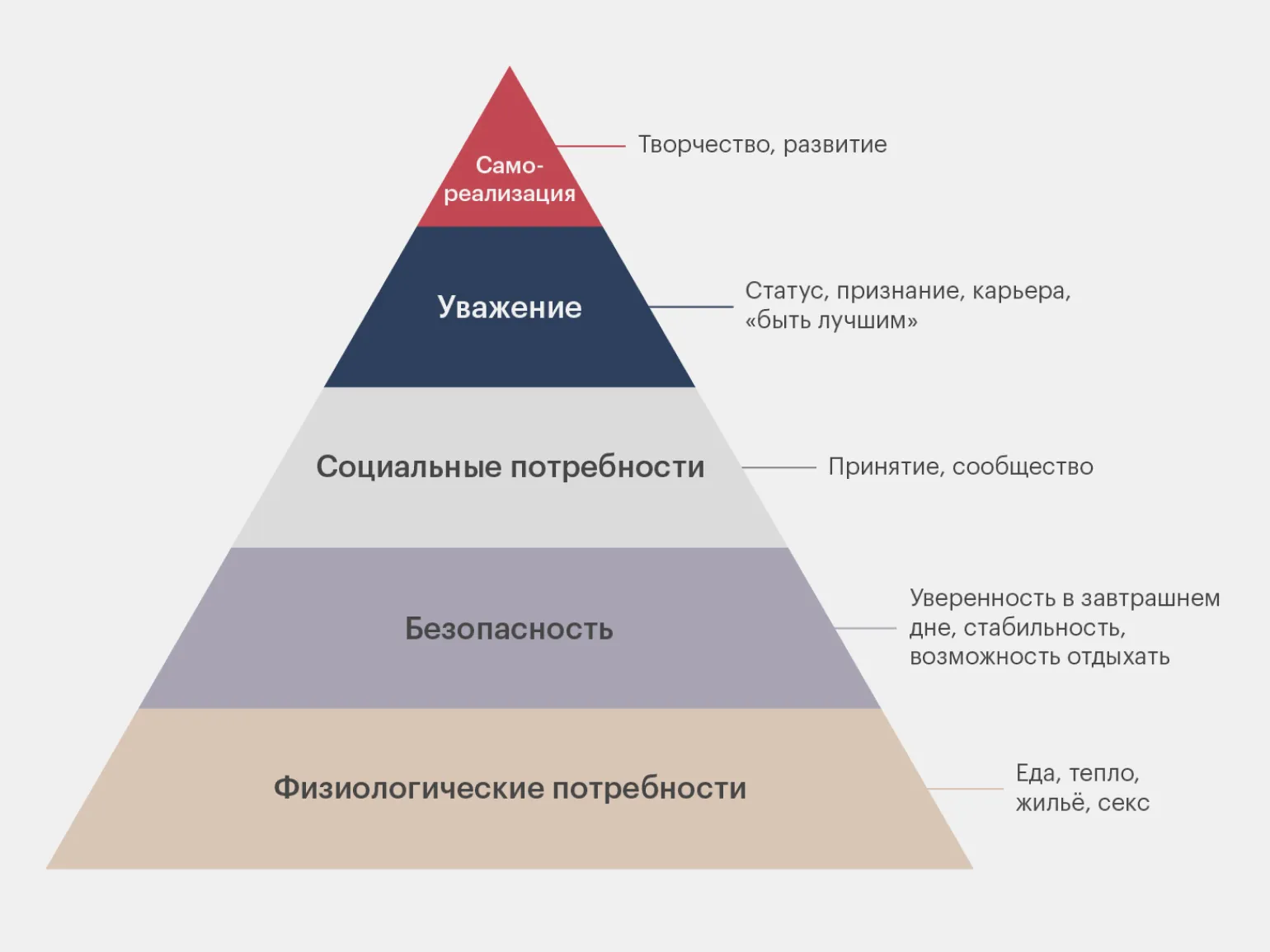
Abraham Maslow's hierarchy of needs is a key concept in psychology, demonstrating a hierarchy of human needs. Notably, Maslow himself did not develop visual diagrams for his theory. The pyramid-shaped visualization was proposed by psychologist Charles McDermid in 1960, six years after the publication of Maslow's book, Motivation and Personality. This hierarchy of needs includes physiological, social, and psychological aspects that help understand how different levels of needs influence human motivation and behavior. Understanding this model can be useful in a variety of fields, from psychology to business and education.
Physiological needs, such as food, water, and shelter, form the base of the needs pyramid and are fundamental to human survival. These needs are essential for maintaining life and health. At the top of the pyramid is self-actualization—the desire to realize one's potential and achieve personal goals. This level reflects the desire for development, creativity, and self-expression, which allows a person to achieve harmony and satisfaction in life.
The Structure of Maslow's Hierarchy of Needs
Abraham Maslow, a renowned psychologist, created one of the most influential models of human needs – Maslow's pyramid. This model classifies needs into five levels, arranged in order of their importance to a person. Each of these categories must be satisfied before an individual can move on to the next level. The pyramid begins with basic physiological needs, such as food, water, and shelter, and rises to higher needs, including safety, social connections, esteem, and self-actualization. Understanding this model allows for a deeper understanding of the motivation behind human behavior and the importance of satisfying basic needs for achieving personal growth and harmony.
The structure of the pyramid of needs is a hierarchy, with the most basic needs at the bottom and higher needs at the top. This model illustrates how satisfying basic needs is the foundation for achieving higher levels, such as social and self-actualization. Understanding this pyramid helps in analyzing human motivation and behavior, as well as in developing strategies for meeting needs at different levels.
At the most basic level are physiological needs, which serve as the foundation of human existence. These include vital factors such as nutrition, hydration, respiration, sleep, and reproduction. Humans instinctively seek to satisfy these primary needs before moving on to higher levels of needs, which is an important aspect in understanding motivation and behavior. Satisfying physiological needs is key to maintaining health and vitality, which in turn affects a person's ability to develop and achieve more complex goals.
The need for safety is an important stage in personal development. It encompasses health protection, financial stability, and environmental security. Without a sense of security, full development is impossible, as a person will not seek self-expression or creativity until they feel confident in their safety. Meeting these basic needs creates the foundation for further growth and the discovery of new opportunities.
Once basic needs are met, a person develops a need for social belonging. Interacting with others, forming a family, and establishing friendships become key aspects contributing to emotional well-being. Social connections not only enrich life but also have a significant impact on mental health and overall quality of life. Building strong relationships with others helps manage stress and increases happiness.
At the stage of esteem and recognition, an individual strives to improve their social status and recognition of their achievements. This is manifested in the desire for education, career advancement, and participation in charitable initiatives. A person begins to recognize the significance of their successes and their impact on the opinions of others, which contributes to the development of self-esteem and self-confidence.
Self-realization represents the highest stage of personal development, during which a person fully realizes their talents and strives for constant personal growth. This stage includes creativity, altruism, and continuous self-improvement. According to Abraham Maslow's theory, it is at the level of self-actualization that a person attains their true nature, realizing their potential and aspirations. Achieving self-actualization allows an individual not only to feel satisfied with life but also to make a meaningful contribution to society, underscoring the importance of this stage in psychological and social contexts.
In later research, Abraham Maslow introduced a sixth level of the hierarchy of needs—transcendence. This level emphasizes transcendence and includes deep spiritual experiences, as well as a sense of oneness with the surrounding world. However, achieving this state is not accessible to everyone, as it requires significant effort and inner work. Transcendent experiences can enrich life, giving it deep meaning and fulfillment.
The Possibility of Moving Through the Levels of Maslow's Hierarchy
According to Abraham Maslow's theory, many believe that moving to the next level of the pyramid is possible only after the needs of the previous level are fully satisfied. However, Maslow himself emphasized that this is not a rigid rule. In reality, people often strive to satisfy several needs simultaneously. This means that personal development can occur in parallel at different levels of the pyramid, and each individual can have a unique path to self-actualization. Understanding this flexibility in needs contributes to a deeper understanding of human motivation and behavior.
Life changes, including moving, changing jobs, or the birth of a child, can significantly alter priorities. For example, the birth of a child in the family often leads to a shift in the parents' focus from personal interests to the care and upbringing of the child. These transformations require a reassessment of goals and adaptation to new circumstances, which can impact daily life and relationships. It is important to understand that such changes may require time to get used to and form new habits, and may also open up new opportunities for personal growth and development.
Abraham Maslow emphasized in his interviews that moving to the next level of the hierarchy of needs does not require complete satisfaction of needs at the current level. He indicated that achieving a certain percentage of satisfaction is sufficient: for physiological needs this is 85%, for safety needs - 70%, for social needs - 50%, for recognition - 40%, and for self-actualization only 10% is enough. These data illustrate the flexibility of his theory and show that people can move up the hierarchy even if there are unfulfilled needs at previous levels.
Maslow emphasized that his theory of the hierarchy of needs is not universal for all people. He identified groups of people for whom his concept may not always be applicable. This is important to consider when analyzing human motivation and behavior, as individual differences can have a significant impact on need satisfaction.
- People for whom self-esteem is more important than love;
- Creative individuals who put creativity above all else;
- Survival-oriented people who focus on meeting basic needs such as food and shelter;
- Individuals with psychological disorders for whom social connections and recognition are unimportant;
- People who do not realize the importance of security because they have never experienced a lack of resources;
- Goal-oriented "martyrs" willing to sacrifice comfort and communication to achieve their goals.
The Relevance of Maslow's Theory in Modern Management
Abraham Maslow, the founder of humanistic psychology, argued that his theory The hierarchy of needs can be effectively applied in business and management. In his 1965 book "Eupsychic Management," published in Russia under the title "Maslow on Management," he emphasizes the importance of not only material motivation but also satisfying higher-level needs to attract and retain qualified personnel. Maslow emphasizes that successful management requires taking into account human factors and creating conditions conducive to employee development and self-realization in the work environment. This approach helps companies not only increase productivity but also reduce employee turnover, which ultimately leads to sustainable growth and business success.
Since then, Maslow's followers have actively implemented his ideas in various fields, including marketing, entrepreneurship, and personal development. The concept that companies, like individuals, experience different needs depending on their stage of development has become the basis for many modern strategies. This theoretical framework allows organizations to better understand the motivations of their employees and customers, which in turn facilitates more effective management and business growth. Applying Maslow's hierarchy of needs in business helps identify the key factors influencing satisfaction and loyalty, which is an important aspect of success in a competitive market. To successfully apply Maslow's hierarchy of needs in business, it is important to determine the level of development of your organization and the corresponding actions. Marketing strategies used in the initial stages differ significantly from those employed by mature and successful companies. Understanding your position in the structure of needs will allow you to more effectively tailor communications with customers and adapt offers to their expectations. This approach will help not only attract new customers but also strengthen the loyalty of existing ones, which will ultimately lead to business growth and increased competitiveness. Developing a comprehensive marketing strategy in the initial stages, when it is only necessary to assess demand, can be ineffective. At the same time, ignoring modern marketing tools in a mature company is also not beneficial. The key is finding the optimal balance and adapting approaches to current business needs. Effective marketing requires flexibility and the ability to quickly respond to changes in the market environment.
Petr Doronin, Commercial Director of Multiways, emphasized the importance of understanding your business's position on Maslow's pyramid. Understanding this position allows you to take appropriate actions that align with the company's current needs and goals. Analyzing the level of need satisfaction, from basic needs to self-actualization, helps build a development strategy and achieve business success.
Application of Maslow's theory in management provides valuable insights for understanding employee motivation and creating successful business strategies. This theory helps identify employee needs, which, in turn, contributes to increased engagement and productivity. For a more detailed study of this topic, it is useful to review the research on the Harvard Business Review website, where you can find relevant materials and practical recommendations for applying Maslow's theory in management.
Application of Maslow's Hierarchy of Needs in Marketing: Strategies and Examples
Maslow's hierarchy of needs is a key marketing tool that allows for a deeper analysis of customer motivation. Using this theory, companies can not only identify their customers' needs but also tailor their offerings to meet these needs. This leads to more targeted marketing strategies that increase customer satisfaction and, as a result, drive sales. Proper application of Maslow's hierarchy of needs helps businesses better understand what drives their target audience and effectively respond to changes in consumer preferences.
If a company offers fast laptop repair services, it's important to focus on customer needs for safety and reliability. Customers seeking a prompt solution to their problems often use their laptop for work and want to minimize the risks associated with downtime. Providing prompt repairs and data recovery can be key to attracting such customers. Emphasize that your service offers not only speed but also quality, which will help satisfy the needs of users seeking a quick and safe repair of their devices.
Advertising campaigns can emphasize the speed of service. For example, you can use phrases like "Find out the cause of the breakdown in just one hour, and the repair will be completed within three hours!" or "Bring your device today - get it back tomorrow with a six-month warranty." Effective advertising that emphasizes the speed and quality of service will attract more customers and increase their trust in your service.
Content marketing expert Milya Kotlyarova shares her experience in developing effective content strategies. She applies Maslow's pyramid to analyze customer needs, which helps determine which needs are satisfied by the product. This approach allows you to focus on key aspects that contribute to increased audience engagement and sales. Using Maslow's pyramid in content marketing is becoming an essential tool for creating relevant and engaging content, which in turn facilitates business growth.
It's important to understand that the same product can satisfy different consumer needs. For example, healthy food not only provides safety for those with gluten and lactose intolerance but also promotes a sense of belonging or self-esteem. Thus, food choice becomes not only a matter of health but also a social and psychological factor affecting quality of life. Healthy eating can shape identity and foster stronger social connections, emphasizing the importance of a conscious approach to food choices.
Healthy eating can combine not only nutritional value but also aesthetic appeal. Attractive food presentation encourages consumers to share photos on social media, which increases interest in healthy recipes and can inspire others to make healthier choices. The visual appeal of healthy dishes plays a significant role in creating a positive image of proper nutrition and promoting a healthy lifestyle.
Content can vary significantly depending on target needs. It can include stylish visual elements, as well as invitations to doctors and nutritionists who will discuss product ingredients and provide dietary recommendations. Furthermore, it is important to create communities of like-minded people where people can share experiences and receive useful information about a healthy lifestyle and proper nutrition. This approach will not only help attract attention to the product but also build trust in the brand, facilitating more active engagement with the audience.
The application of Maslow's theory in marketing also includes an analysis of changing customer needs. For example, during the COVID-19 pandemic, consumer emphasis shifted to safety, significantly altering their behavior. Previously focused on self-actualization, buyers began to pay more attention to health and safety issues. These changes require marketers to be flexible and adapt their strategies to meet the new expectations and needs of their audience. Monitoring such trends allows companies to promptly respond to customer requests and offer relevant solutions.
The growing demand for at-home COVID-19 testing services has prompted laboratories to quickly adapt, offering PCR tests without the need to visit a healthcare facility. This is convenient for patients and helps reduce the risk of spreading the virus, ensuring access to quality medical care at home. These measures have become an important step in the fight against the pandemic, allowing people to stay safe while still being able to get tested in a timely manner.

Join our Telegram channel dedicated to digital marketing. We offer relevant information, useful books, news discussions, and the opportunity to win tickets to free events. Stay on top of the latest trends and improve your digital marketing skills with us.
How Maslow's Hierarchy of Needs Helps Motivate Employees
Effective HR management requires a deep understanding of the level of each employee's hierarchy of needs. This knowledge allows you to adapt motivation methods to meet the individual needs of employees. For a more detailed study of the application of this theory to HR management, we recommend consulting authoritative sources such as Harvard Business Review and SHRM. These resources offer valuable insights and practical recommendations that will help improve your approach to motivation and enhance team performance.
HR experts, including coaches and executives, actively use Maslow's pyramid in their practice. This approach allows for a deeper understanding of employee motivation and effective team management. Maslow's pyramid helps identify employee needs, ranging from basic physiological needs to self-actualization. This model helps create a more comfortable and productive work environment, which directly impacts business performance. Experts confirm that considering and understanding employee needs at different levels of the pyramid leads to increased satisfaction and engagement. Anton Volkov, co-founder of Solvery, notes that Maslow's pyramid serves as an effective tool for visualizing employee career growth. Working in the IT sector, we often encounter professionals seeking career development at various levels. The steps of the pyramid, from level two to level five, represent the stages at which employees seek security, socialization, and recognition. This understanding helps us better support our specialists in their professional development and achieve shared goals.

When moving to IT, many specialists strive for stability and comfortable working conditions. A new professional, starting their first job, needs support at various stages of their career development. Anton Volkov emphasizes the importance of assistance with professional growth, recognition, and career advancement. This not only facilitates the successful adaptation of new employees but also improves overall team productivity. By focusing on skill development and career advancement, companies can create a more effective and motivated environment for their employees.
The first and second levels of the pyramid of needs represent basic physiological needs and safety. Once satisfied, advancement to higher levels, such as recognition, respect, and self-actualization, is possible. These levels are continuous and act as incentives for the growth of both employees and the organization as a whole. Satisfying basic needs creates a solid foundation for achieving personal and professional goals, which, in turn, contributes to the company's development and increases its competitiveness in the market.
In Russia, employee development is perceived not as an end in itself, but as a means to achieving strategic business goals. An effectively developed team achieves its goals faster. Satisfying employees' needs for recognition and self-actualization is becoming a key success factor, as companies can offer their employees new areas of responsibility and opportunities for career advancement. Thus, by investing in employee development, organizations not only increase productivity but also create a motivated team capable of addressing market challenges.
Many organizations use flat structures and career matrices to develop their employees. This approach allows for expanded responsibilities and greater influence within the company. Career matrices help clearly define growth opportunities, which not only facilitates employees' professional development but also strengthens the team as a whole. Effective use of such tools increases employee motivation and promotes better collaboration within the company.
Yulia Kopylova, a mentor at Solvery, shares her experience using Maslow's pyramid in one-on-one meetings. She notes that when employee motivation declines, basic needs are often already met. However, newcomers may have difficulty being accepted into the team. In such cases, Yulia employs team-building techniques, including joint projects and strategic sessions, which help strengthen team spirit and increase motivation.
To motivate experienced employees, challenging tasks and training programs are effective. This allows them to satisfy their needs for recognition and professional growth, which in turn contributes to increased engagement and productivity in the workplace. Providing opportunities for continuous development and solving non-standard problems plays a key role in retaining qualified specialists and creating an atmosphere of innovation within the company.
Ulugbek Kamolov, founder of UniStudy, emphasizes the importance of Maslow's pyramid in corporate culture, but notes that its application does not always produce the desired results. "We meet the basic needs of our employees through a system of bonuses and awards and support their development. For example, we provided an employee with leave to pursue an education in the USA, which allows him to feel confident about the future," shares Ulugbek. It is important to note that creating a comfortable work environment and opportunities for professional growth help to increase employee motivation and satisfaction, which in turn affects the overall productivity of the company.
Providing employees with opportunities for training and self-improvement significantly increases their satisfaction and the quality of their work. However, the concept of Maslow's pyramid does not take into account individual goals and interactions between employees, which can lead to overload. A more effective approach is to focus on support and solving actual problems, instead of mindlessly insisting on development. This helps create a more harmonious work environment where each employee can grow in accordance with their needs and priorities.
Maslow's Hierarchy of Needs: Key Aspects
Maslow's theory of needs is a key tool for studying human motivation. It demonstrates how people strive to satisfy their needs, starting with basic needs, such as physiological needs, and gradually moving on to more complex ones, including social and self-actualization. This theory helps us understand how different levels of needs influence behavior and decision making. Understanding Maslow's needs can be useful in a variety of fields, including psychology, human resources management, and marketing, as it provides a deeper understanding of customer and employee motivation.
According to this theory, physiological needs, including food and water, are at the base of the pyramid. Safety needs are at the next level, followed by social needs. Next come the needs for recognition, and at the top of the pyramid is self-actualization. This structure helps us understand the hierarchy of human needs and their influence on motivation.
Although the theory suggests that people should prioritize basic needs, in practice, higher needs may become more important in certain circumstances. For example, in stressful situations or in times of crisis, the value of recognition and self-actualization can increase significantly. This emphasizes the importance of emotional and mental well-being, as well as the desire for personal growth, which can become a priority for many people during difficult times in their lives.
In marketing, Maslow's concept of needs is actively used for an in-depth analysis of the target audience. This allows companies to develop more effective and targeted advertising campaigns that address the varying levels of customer needs. In HR management, this model helps identify employee motivation, which in turn helps create comfortable working conditions and satisfy their needs. Applying Maslow's theory in these areas helps improve communications and strengthen relationships with both customers and employees.
Maslow's theory of needs is based on the psychologist's personal observations and is not supported by rigorous scientific research. While it can be useful in practice, it is important to understand that it does not represent a universal law of human behavior. This theory identifies various levels of needs, ranging from basic physiological needs to the need for self-actualization, which allows for a better understanding of human motivation. However, it should be borne in mind that individual differences and cultural context can influence each person's behavior and needs.
Internet Marketer: 5 Steps to a Successful Career
Want to become an internet marketer? Find out how to launch advertising and achieve results in 5 steps! Read the article.
Find out more