
Contents:
- The Importance of Questions in Negotiations: Differences Between Large and Small Deals
- How the SPIN Selling Model Works
- C — Situational Questions: The Basics of Successful Communication
- Why Are Situational Questions Important?
- Frequently Asked Questions
- Problem Questions: The Key to Understanding Customer Needs
- Implication Questions: The Key to Successful Sales
- Guiding Questions: How to Effectively Translate Conversation to Solutions
- Effective strategies for closing large deals
- Who is SPIN selling suitable for?

Sales Manager Course: 5 Steps to Success
Learn moreThe Importance of Issues in Negotiations: Differences Between Large and Small Deals
The SPIN methodology, created by Neil Rackham and his research team, is the result of an in-depth analysis of sales strategies. The study involved 22 companies from 23 countries, analyzing over 35,000 conversations between salespeople and prospects. This data formed the basis for understanding the key factors that contribute to successful sales. The SPIN methodology emphasizes the importance of asking questions that help identify customer needs and offer the most appropriate solutions. This approach helps build trust between the seller and the buyer, which significantly increases the chances of a successful deal.

Rackham identifies four key stages that most negotiations go through. Each of these stages plays a vital role in successfully completing the negotiation process. Understanding these stages allows you to better prepare for negotiations and increase your chances of achieving the desired outcome.
- Initiation of the meeting. Participants introduce themselves and the conversation begins. In the first two minutes of communication, the client forms a first impression, which determines the possibility of a successful sale.
- Research. The seller asks questions about the buyer and their company, which allows them to gather information about the client's needs.
- Demonstration of possibilities. The seller shows how their offer can solve the buyer's problems.
- Obtaining a commitment. A successful meeting ends with a commitment from the client, for example, agreement to a product demonstration or testing.
Rackham's second key finding is that methods used for small sales are ineffective when dealing with large transactions. Traditional strategies focused on demonstrating product features and closing the deal do not always ensure success in the case of expensive goods and services. Achieving results in large sales requires a different approach, one that takes into account the specifics and needs of clients.
The stage of researching client needs is key to successful large sales. Salespeople who know how to ask the right questions achieve significantly better results. Research conducted by Rackham confirms that specific closing techniques and handling objections are less important in the context of large sales. Focusing on client needs allows not only for a better understanding of their needs but also for building long-term relationships, which ultimately leads to higher sales.
Neil Rackham identifies three main reasons explaining the differences between small and large sales. First, small sales often require less time and resources to close the deal, while large sales can be protracted due to the need to coordinate with multiple stakeholders. Second, large sales require a more in-depth understanding of the client's needs, which requires a high level of skill and knowledge on the part of the salesperson. Third, small sales are usually built on standardized proposals, while large deals require an individual approach and adaptation of the proposal to the specific needs of the customer. Understanding these differences allows you to effectively develop sales strategies for different types of deals.
- The length of the deal life cycle varies. Small sales can be closed in a single meeting, while large deals require multiple negotiations that can take months.
- The severity of decision-making. The more expensive the product, the more the client is afraid of making a mistake that can lead to discussions within his company.
- The influence of other decisions. Different specialists can be involved in negotiations, and the client does not always make the purchase decision on his own. This makes the research stage more important than just a presentation.
Sales success is closely linked to conducting high-quality research and formulating the right questions. Analyzing the practices of successful salespeople, Rackham identified four categories of questions that formed the basis of the SPIN model. In the next section, we'll explore this model and its application in sales in detail.
How SPIN Selling Works
The SPIN Selling model, created by Neil Rackham, is a strategy aimed at optimizing salespeople's interactions with customers. The basic idea is to ask different types of questions sequentially, which helps smoothly move the customer toward a purchasing decision. This methodology identifies key categories of questions that play an important role in the sales process. Effective use of these questions allows salespeople to better understand customer needs and offer them the most appropriate solutions.
- Situational questions - help to clarify the client's current situation and its context;
- Problem questions - focus attention on existing difficulties that require a solution;
- Implication questions - demonstrate to the client the advantages and benefits of solving the problem;
- Guiding questions - lead the client to the understanding of the need to close the deal.
The following image shows a detailed diagram of the SPIN selling model, demonstrating the interrelationship of key questions used in the sales process. This model helps to effectively identify customer needs and build a constructive dialogue, which contributes to an increase in the level of successful transactions.
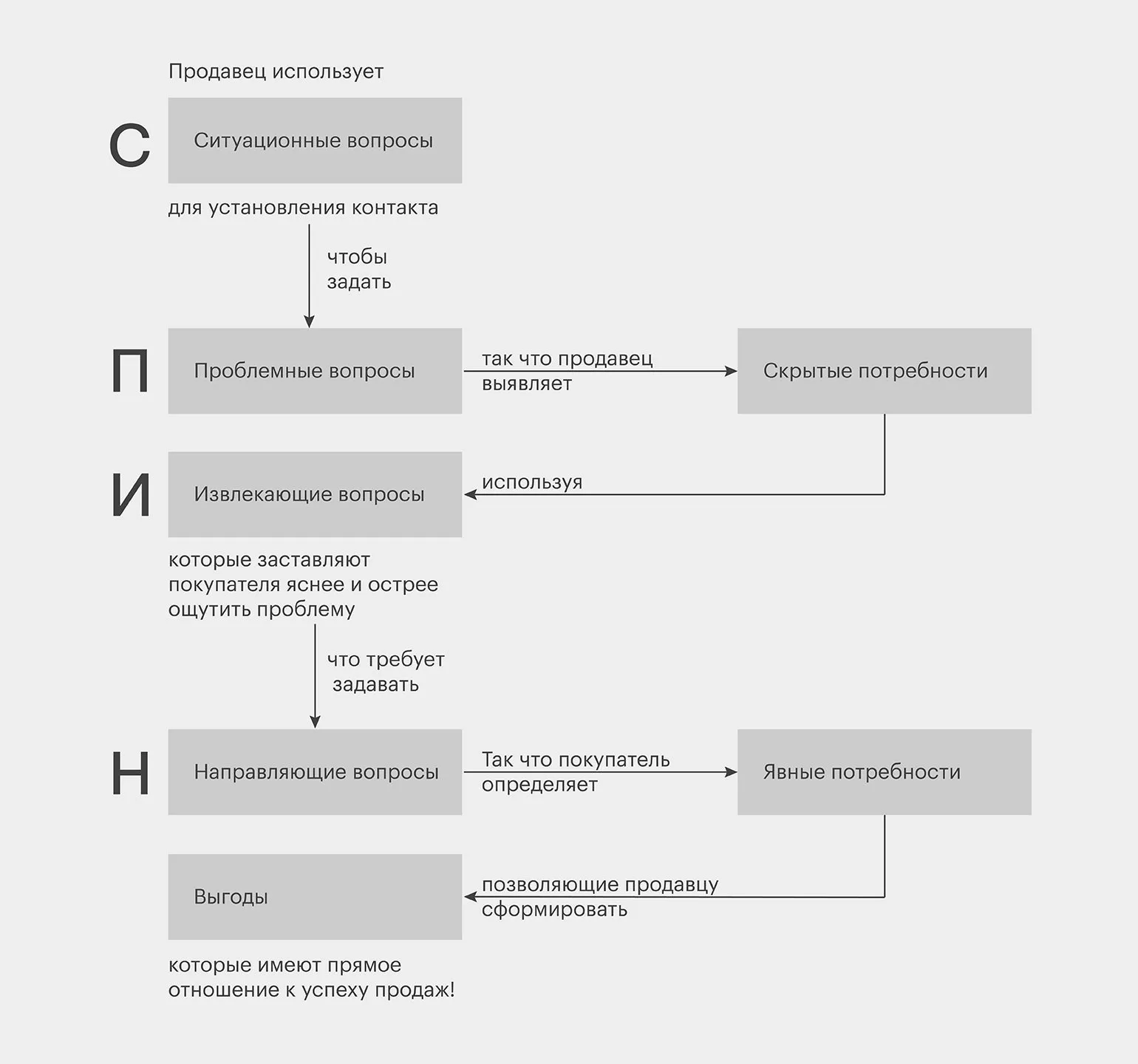
The SPIN model should not be perceived as a rigid guide. Rackham emphasizes that the key to the success of this technique lies in the ability to ask questions that have real meaning for the client, and not just in systematizing them. Each seller should customize their approach depending on the specific situation and the uniqueness of the buyer. This flexible approach allows them to better understand the client's needs and offer them the most appropriate solution.
C — Situational Questions: The Basics of Successful Communication
Situational questions play a key role at the beginning of business communication. They allow you to determine the current state of your potential client's business and serve as a basis for further negotiations. Examples of situational questions may include inquiries about current business processes, problems the company faces, as well as the goals and objectives the client has set for themselves. Using the right situational questions helps establish trust and gain a deeper understanding of the client's needs, which in turn leads to more effective solution offerings.
- What equipment does your company use?
- How many employees work in your department?
- How long has your team been in existence?
Situational questions play a key role in establishing trust with the client and understanding the context of their needs. This stage is important because it helps the potential buyer relax and feel comfortable in the conversation. They realize that they are being engaged in a sincere dialogue, rather than being sold a product. This creates the basis for deeper interaction and contributes to the formation of long-term relationships with the client. Correctly formulating situational questions helps identify the client's needs and preferences, which ultimately leads to more effective sales and increased customer satisfaction.
It should be noted that too many situational questions can cause a negative reaction from the client. If you ask too many of them, it can be perceived as intrusive. Therefore, it is important to limit yourself to the necessary minimum of questions and gradually move on to more in-depth problematic questions. This will help you better understand the client's needs and establish a trusting relationship.
Why are Situational Questions Important?
Situational questions play a key role in establishing rapport with the client and help identify their problems. This approach is an important stage in the successful sales process, since without a deep analysis of the current situation, it is impossible to offer truly effective and valuable solutions. Understanding the client's needs through situational questions helps build trust and increases the likelihood of a successful deal.
Frequently Asked Questions
Salespeople often face a number of questions that require attention. These questions relate to various aspects of sales activities and can significantly impact the success of the business. For example, how to effectively attract clients, which methods of product promotion are the most effective, and how to optimize the sales process. In addition, sellers are interested in how to improve customer service and what technologies can help with this. Answers to these questions will help sellers increase their competitiveness and increase sales.
- How to determine which situational questions to ask?
- How to avoid irritating the client when asking questions?
- How to use the answers obtained for further sales?
Answers to these questions help increase your sales success and establish trusting relationships with clients.
Problem questions: the key to understanding customer needs
Problem questions are key tools in the sales process, as they allow you to identify the real needs, difficulties, and pain points of clients. These questions help deepen your understanding of the client's situation and focus your offer on solving their problems. Examples of such questions might include:
- How comfortable are you using this technique?
- Have you encountered any problems related to the quality of raw materials?
- Are you satisfied with the current services/products on the market?
According to sales expert Neil Rackham, the number of problem questions can exceed the number of situational ones. However, to achieve maximum effectiveness, such questions should be carefully developed and formulated. This will allow for a deeper understanding of the client's needs and identify the true problems that require solutions. It is important that the questions not only touch on the topic but also clarify the essence of the issue under discussion, facilitating a more productive dialogue between the seller and the client.
Preparing to ask problem questions is a key step in the sales process. It is recommended to create a list of three to six key pain points or needs that your product or service can solve in advance. This will allow you to more accurately understand what your customers may be facing. After that, it is important to develop several problem question formulations that will help identify these problems and needs in your customers. This approach will not only improve communication but also increase the likelihood of a successful sale, as you will be able to offer a solution that meets their needs.
Implication Questions: The Key to Successful Sales
The traditional sales approach typically involves the salesperson identifying a customer's problem and then offering a corresponding solution. In contrast, the Rackham technique offers an alternative strategy in which the salesperson must show the customer that their problem has more serious implications than they themselves realize. In this context, implication questions are particularly effective, as they help to gain a deeper understanding of the customer's needs and reveal the scope of their problem. Using this technique not only helps establish trust but also increases the likelihood of a successful sale, as the client begins to recognize the need to solve their problem.
These questions help establish a connection between the client's problems and their business goals. Below are some examples of effective elicitation questions:
- How has this affected your bottom line?
- Could this increase your operating expenses?
- How might this hinder your planned expansion?
Implicative questions play a key role in the major sales process. The client must not only recognize their problem but also be willing to allocate funds to solve it. When offering an expensive product, it is critical to balance its cost with the value provided. This value equation allows the client to see that the investment in the product is justified and will lead to real benefits. Effective use of elicitation questions helps to uncover the client's needs and build trust, which ultimately contributes to a successful transaction.

Elicitation questions should probe the client's problem in more depth so that the solution becomes clear and necessary. It's important to be sensitive: phrase your questions in a way that helps the client understand how their problem relates to their values. This approach not only promotes effective communication but also builds trust between the parties, which can ultimately lead to a more successful resolution.
The book "SPIN Selling" features an example of a salesperson using elicitation questions. This allows the client to independently understand the costs of training their staff. This approach helps the customer better understand their needs and financial investment, which can ultimately lead to more informed purchasing decisions.
Salesperson: Have you noticed any difficulties your operators face in operating the machines?
Buyer: Yes, we have encountered some difficulties, but we have been able to adapt to the new conditions successfully.
Salesperson: How does this affect your production performance?
Buyer: Overall, the impact on the process has been minor, since we have trained three employees.
Salesperson: Doesn't it create problems because only three of your employees are trained to operate these machines?
Buyer: Yes, there are problems when an employee leaves and we need to find a replacement and train a new employee. This creates additional costs and slows down work processes.
Salesperson: These difficulties can indeed contribute to high turnover among skilled operators.
Customer: Indeed, employees are not interested in working on these machines, which leads to high turnover.
Salesperson: What are your costs for training a new operator, taking into account turnover?
It will take about two months of training and approximately $5,000 for an operator to reach the required skill level. This year, we have successfully trained five operators.
Guiding Questions: How to Effectively Translate the Conversation to Solutions
In the previous step, we convinced the client of the importance of their problem. Now it's time to offer them a solution in the form of our product or service that will help them effectively cope with this situation.
Here are some example questions that can serve as useful starting points in your process. These questions will help you structure your thoughts and improve your understanding of the topic.
- Do you need ...?
- How would it help you if you had ...?
- Would it help you solve your problem if we offered ...?
Using leading questions allows the seller to shift the client's focus from the identified problem to a potential solution. As a result, the client begins to independently voice the benefits, which significantly simplifies the sales process and contributes to the successful closing of the deal. This approach not only activates the client's interest, but also helps create a more trusting atmosphere conducive to effective interaction.
When conducting meetings, it is important to keep in mind that leading questions should not be asked at the very beginning of the discussion. Also, you should not use them if your product or service does not solve the client's stated problem. Sales expert Neil Rackham emphasizes that inappropriate questions can lead to mistrust on the part of the client and significantly reduce the likelihood of a successful deal. To improve the effectiveness of communication with clients, focus on creating an atmosphere of trust and adequately analyzing needs before moving on to specific questions.
Effective Strategies for Closing Large Deals
Closing a deal is a key moment in the sales process, especially when significant financial investments are involved. After the client has successfully completed all stages of interaction and you have prepared them for a decision, it is crucial to obtain a clear commitment from them. Effective closing of the deal ensures not only the closure of the current process but also lays the foundation for further customer relations, which can lead to repeat sales and referrals.
According to Neil Rackham, classic closing methods successfully used in small businesses prove ineffective when dealing with large sales. This problem is especially relevant when interacting with experienced buyers with whom you expect to establish long-term business relationships. In such situations, it is important to employ a more strategic approach that takes into account the specifics of large transactions and client needs.
According to Rackham's model, successful closing begins with a clearly defined meeting goal. It is important to determine in advance the desired outcome for the client. This may include not only a sale, but also obtaining contacts of key individuals or scheduling a follow-up meeting. A clear understanding of the goal allows you to more effectively communicate and manage the sales process, which ultimately increases the likelihood of a successful deal.
- Focus on researching and demonstrating opportunities. In large sales, an order will not be received until the client recognizes the need for your product. Use exploratory questions to uncover the client's needs.
- Make sure all key issues are covered. To avoid doubts and misunderstandings, ask the client if there are any other points they would like to discuss. This could be clarifying the terms of cooperation.
- Summarize. In major negotiations, it is important to summarize the key points so that the client can focus on them and not miss important details.
- Suggest the next step. Successful salespeople don't ask questions at the closing of a deal, but offer options, for example, by scheduling a product demonstration.
An example of a successful deal closing from Neil Rackham demonstrates the important aspects of effective negotiations and sales. Neil Rackham, author of "Spin Selling", offers a unique approach to the sales process based on understanding the client's needs and building trust. The key stages of his methodology are research, problem identification, solution demonstration, and securing agreement. Effective closing requires active listening, asking the right questions, and a willingness to adapt to the client's needs. This approach not only increases the chances of a successful sale, but also helps build long-term partnerships. Neil Rackham's successful closing example serves as a valuable lesson for anyone looking to improve their sales and negotiation skills.
Salesperson: Are there any additional questions we haven't covered?
Buyer: At this point, I think we've covered everything.
Salesperson: We discussed how the new system will improve order fulfillment speed and streamline the processing process. We also covered cost control methods, which will allow you to significantly reduce expenses. Switching to a new system will provide you with significant benefits, especially in terms of reliability.
Buyer: Your resume really makes switching to a new system very appealing.
Salesperson: Would you like to learn more about our system? I can offer you to choose a convenient time to demonstrate it in action.

Who is SPIN selling suitable for?
SPIN selling is the optimal solution for complex transactions with long cycles that require multiple meetings and the involvement of various stakeholders. These techniques have proven effective in a number of industries, such as information technology, financial services, consulting, and healthcare. They help salespeople identify customer needs, build trust, and establish long-term relationships, which is critical in a highly competitive market. Using SPIN selling not only increases sales but also improves customer service, which in turn strengthens the company's position.
- B2B sector - goods and services.
- Expensive purchases that are made infrequently: apartments, cars, country real estate.
- Educational services.
- Consulting services.
- Long-term and comprehensive services: legal, accounting, financial.
The use of the SPIN technique is not always mandatory, even when selling high-value goods. If you're trying to persuade a manager to schedule a meeting with a key decision-maker, using elicitation and guiding questions can be very helpful. These questions will help create a sense of value in the upcoming meeting. However, if your goal is to establish rapport with a junior technical specialist, using SPIN questions may not produce the desired results. It is important to choose the appropriate strategy depending on the level of the interlocutor and the goals of the communication.
Sales Manager: 5 Key Skills for Success
Do you want to become a successful sales manager? Learn 5 key skills and start a career in sales!
Learn more