
Contents:
- Understanding Attribution Models: Their Meaning and Application
- Why It's Important to Use Attribution Models in Marketing
- Popular Attribution Models: What You Should Know
- Conclusion
- Overview of Attribution Models in Yandex.Metrica
- Overview of Attribution Models in Yandex.Direct
- Overview of Attribution Models in Google Analytics
- How to Choose the Right Attribution Model for Your business
- How to deepen your knowledge of analytics

18 Free Marketing Courses: Increase Your Revenue Today!
Learn MoreUnderstanding Attribution Models: Their Meaning and Applications
Attribution models are rules that help determine which traffic channel should be credited for achieving a conversion. They allow you to understand how to distribute credit among different traffic sources when a user interacts with several of them before taking a target action. Using attribution models allows you to more accurately evaluate the effectiveness of marketing campaigns and optimize your budget, directing funds to the most effective channels. This is especially important in a competitive market, where the correct interpretation of data can significantly increase ROI.
Consider a situation where a user arrives at a website through a search engine but does not make a purchase. Later, they click a link in a social media post, read the article, and then see a contextual ad, ultimately making a purchase decision. An attribution model identifies which of these sources—search, social media, or contextual advertising—led to the conversion. This helps marketers allocate resources more effectively and optimize customer acquisition strategies to maximize return on investment. Attribution is an important tool in analytics and advertising. Attribution models in analytics allow for a more detailed study of user behavior and their path to conversion. In advertising, attribution helps identify the most effective channels for generating leads and increasing conversions. Using this data, companies can make more informed decisions to optimize advertising campaigns and improve their effectiveness. Proper attribution helps improve ROI and further analyze marketing strategies.
- Optimally allocate and redistribute budgets between different channels;
- Efficiently manage costs when paying for conversions;
- Increase return on investment (ROI) in advertising;
- Abandon ineffective channels that do not generate conversions.
Why is it important to use attribution models in marketing?
Attribution models are an important tool for evaluating the effectiveness of marketing channels. They allow you to analyze the customer's journey in detail from the first interaction to the purchase, which helps identify key stages and determine which channels actually contribute to conversion. Proper use of attribution models helps marketers optimize their strategies and budget allocation, focusing on the channels that generate the best results. Thus, attribution becomes the basis for making informed decisions in marketing campaigns.
The company runs display advertising on social networks such as VKontakte to increase brand awareness. At the same time, it receives traffic from contextual advertising in Yandex.Direct and search engines. At first glance, it may seem that display advertising does not generate sales. However, an analysis of attribution models shows that it plays a key role in establishing a user's first contact with the brand. This confirms the importance of an integrated approach to advertising, where display campaigns serve as the foundation for further engagement with potential customers.
Display advertising plays a key role in brand promotion, not only informing about its existence but also actively engaging potential customers in the sales funnel. Refusing display advertising can negatively impact overall marketing effectiveness, which in turn will lead to a decrease in sales. Investing in media advertising will help increase brand awareness and attract more customers, contributing to business growth. Skillbox's analytics courses offer unique opportunities for in-depth exploration of this field. They are suitable for both beginners and experienced professionals looking to expand their knowledge and skills. Participants gain access to up-to-date methods and tools that will help them become sought-after specialists in the job market. The training includes practical assignments and projects, allowing them to apply their acquired knowledge in real-world situations. Skillbox offers flexible training formats, making courses accessible to everyone.
- The "Web Analyst from Scratch to Junior 2.0" course is ideal for starting out in the profession or for advanced training.
- The "Web Analyst Profession" program is an in-depth course for mastering data automation and visualization using SQL.
- The "Marketing Analyst Profession" course will help you automate analytics and evaluate the effectiveness of advertising campaigns both online and offline.
Modern attribution analysis tools, such as Google Analytics and Yandex.Metrica, offer detailed reports and visualizations, making it significantly easier to study user behavior. These platforms allow marketers not only to track traffic sources but also to evaluate the effectiveness of advertising campaigns. Using the data obtained, companies can optimize their marketing strategies, increasing conversions and improving the user experience. Effective attribution analysis is becoming a key element for digital marketing success.
Popular Attribution Models: What You Need to Know
Attribution models are an essential tool in marketing analytics. They allow you to determine which channels drive conversions and evaluate their effectiveness. In this article, we'll look at five of the most popular attribution models to help you better understand how credit is distributed across different marketing channels. Understanding these models will help you optimize your marketing strategies and improve conversion rates.
The "last interaction" attribution model attributes the entire conversion to the last traffic source. For example, if a user has gone through several stages, such as display advertising, targeted advertising, and search, the conversion will be attributed to the last source—in this case, contextual advertising. This model is used to evaluate the effectiveness of marketing channels, but it's important to note that it doesn't reflect the entire user journey and may underestimate the contribution of previous traffic sources. For a more complete picture of conversion, it's recommended to consider other attribution models that take interactions at all stages of the customer journey into account.
This model, known as "last paid interaction," focuses exclusively on conversions from paid advertising sources, ignoring direct clicks and conversions from bookmarks. If a user first visited the site through contextual advertising and then returned via a bookmark, the conversion will be attributed to the contextual advertising. This approach allows you to more accurately evaluate the effectiveness of advertising campaigns and determine which traffic source drives the most conversions.
The First Click model tracks conversions based on the first traffic source. This is an important tool for analyzing how users first learn about your product. In the example shown, all conversions would be attributed to display advertising. Using this model allows you to more accurately evaluate the effectiveness of primary marketing channels and understand which ones are most attractive to your audience.
The Linear model distributes conversions evenly across all stages of the user journey, meaning that each traffic source, including display advertising, targeted advertising, search engine optimization, and contextual advertising, receives an equal share of the conversion. In this model, each of the four sources receives 25% of the total conversion. This allows you to more fairly evaluate the effectiveness of various marketing channels and optimize customer acquisition strategies.
This model distributes the credit for conversions unevenly. The first and last interactions each account for 40% of the conversion rate, while the remaining 20% is distributed among intermediate channels. In the example given, display and contextual advertising each account for 0.4% of the conversion rate. This emphasizes the importance of all stages of the customer journey and demonstrates how different channels influence the overall effectiveness of marketing efforts. This approach allows for a more accurate assessment of each channel's contribution to the conversion process and optimizes marketing strategy.
In practice, the most common model is the Last Non-Direct Click model. This model is standardly applied in many analytics systems and is ideal for quickly analyzing conversion channels, especially in sectors with short sales cycles. The Last Non-Direct Click model allows for a more accurate assessment of the effectiveness of various traffic sources, excluding direct visits. This makes it especially useful for marketers looking to optimize their advertising strategies and increase conversions. Using this model helps identify key channels that drive customer acquisition and sales, which is especially important in a competitive market.
Other attribution models, including linear and positional, become especially important when analyzing the entire sales funnel. This is especially true for companies with long transaction cycles or when assessing the effectiveness of image advertising. It's worth noting that in addition to these models, there are less common attribution options that can also be useful for a deeper understanding of customer behavior and optimizing marketing strategies.
Large brands and companies with long sales cycles create unique attribution models to more accurately analyze their marketing efforts. These models help determine which channels and strategies are most effective and also allow for the optimization of advertising budgets. Effective attribution analysis improves customer engagement and conversions, which in turn drives business growth.
Conclusion
Optimal use of attribution models can significantly improve the effectiveness of marketing strategies and increase return on investment (ROI). For more detailed analysis and evaluation of marketing channel performance, we recommend using tools such as HubSpot and Google Analytics. These resources provide valuable data that will help marketers better understand user behavior and optimize advertising campaigns. Investing time in understanding attribution models and analytics can significantly improve business results.
Overview of Attribution Models in Yandex.Metrica
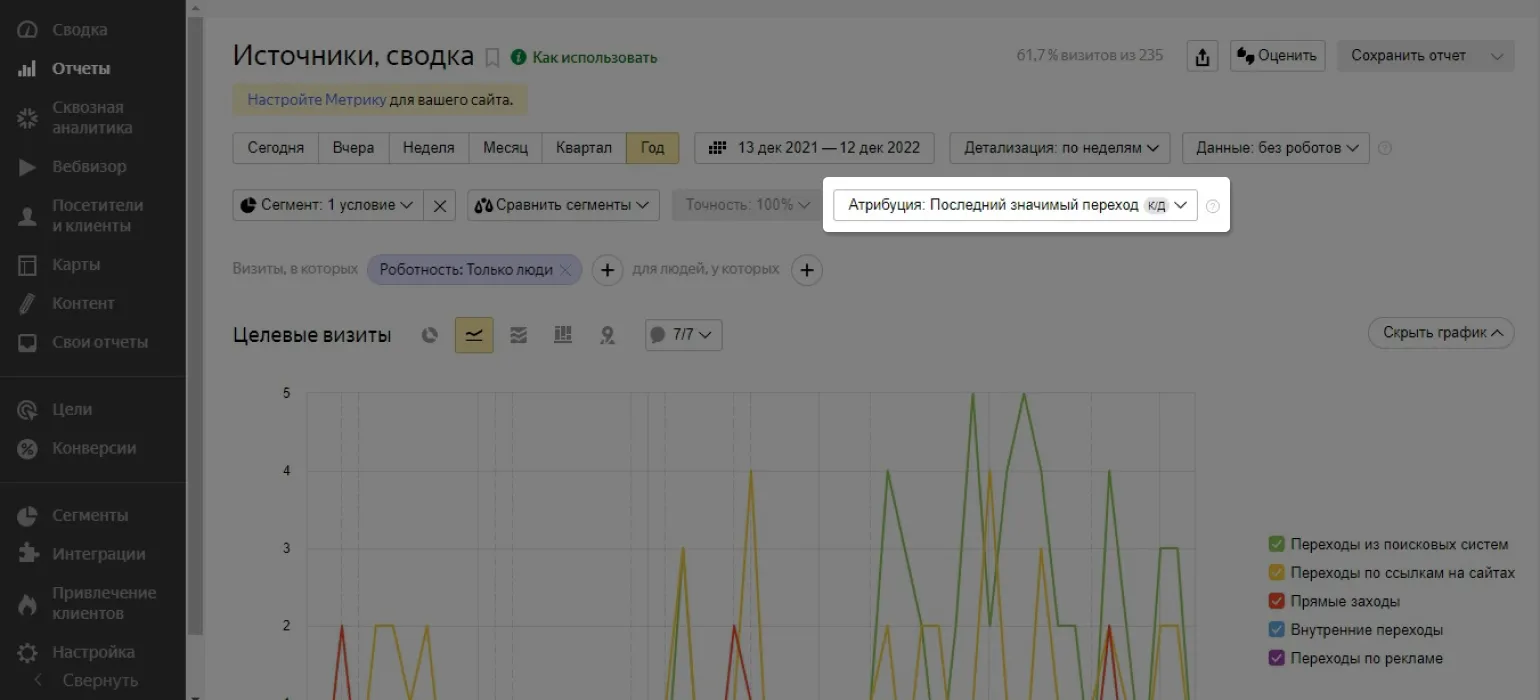
Yandex.Metrica offers four main attribution models: First Click, Last Click, Last Non-Direct Click, and Last Click from Yandex.Direct. These models help you understand how different marketing channels influence conversions. The First Click model emphasizes the user's first interaction with an ad, while Last Click emphasizes the final channel before conversion. Last Non-Direct Click ignores direct visits, allowing you to more accurately assess the contribution of other sources. The Last Click from Yandex.Direct model focuses on clicks from contextual advertising, which is also important for analyzing the effectiveness of advertising campaigns. Using these attribution models helps optimize marketing strategies and increase ROI.
The "Last Click from Yandex.Direct" model focuses on conversions that occur after the last interaction with ads. This model allows for a deeper analysis of how contextual advertising in Yandex.Direct influences user purchasing decisions. Understanding this aspect is key for marketers, as it helps optimize advertising strategies and improve the effectiveness of advertising campaigns. Using this model, you can more accurately evaluate advertising results and adjust approaches to achieve the maximum return on investment.
Attribution models in Yandex.Metrica are applicable to many standard reports. For example, using the Last Non-Direct Click model, you can determine that a significant portion of blog visitors come from search engines. This emphasizes the importance of SEO optimization for increasing traffic and improving site visibility. Using attribution models allows you to more accurately evaluate the effectiveness of marketing strategies and focus your efforts on the channels that deliver the greatest benefit.

Overview of Attribution Models in Yandex.Direct
Choosing an attribution model in Yandex.Direct is a critical aspect for identifying valuable sources of conversions for your business. This is especially important for pay-per-click advertising campaigns, since the chosen model determines which visits will be included in your cost calculations. Properly setting up attribution allows you to more accurately evaluate the effectiveness of advertising channels and optimize your budget, which in turn leads to increased conversions and a higher return on investment. Given the variety of attribution models, it is important to choose the one that best suits your goals and strategy to maximize the effectiveness of your advertising budget.
The Yandex.Direct system offers four key attribution models, which correspond to those used in Yandex.Metrica. These models allow for a more accurate assessment of the effectiveness of advertising campaigns and user interactions with ads. Each attribution model has its own characteristics and can be selected depending on business goals and the characteristics of the target audience. Choosing the right attribution model helps optimize advertising costs and increase conversions, which is an important aspect of successful online marketing.
First Click is the cost of visits after which users return to the site from other sources and convert. This approach allows for effective tracking and analysis of user interactions across various channels, which helps optimize marketing strategies and improve the overall effectiveness of advertising campaigns. Investing in the first click helps attract the target audience and increase conversions, which in turn contributes to business growth.
Last Click is a model in which you pay only for visits that directly lead to the user's desired action. This strategy allows for accurate tracking of advertising campaign effectiveness and determines which traffic sources are most successful in converting. Using the Last Click model, you can optimize your marketing efforts by focusing on the channels that deliver the best results. This approach helps you allocate your budget more efficiently and improve your overall return on investment.
Last Non-Direct Click: This method accounts for visits that resulted in a conversion but did not involve referrals from other sources. For example, if a user sent a link via messenger and then used it to visit your website, this conversion will be recorded as a Last Non-Direct Click. This approach allows you to more accurately assess the contribution of various channels to the user's decision to purchase or perform another target action.
Last click from Direct means that you pay for all visits that came from ads placed in Direct, provided that they resulted in a conversion. This means that even if the user subsequently visited your website through social media, you will still be charged for their initial visit from Direct. This is an important aspect to consider when planning your advertising budget and evaluating the effectiveness of your advertising campaigns. Direct's algorithms are customized for each attribution model. When changing a model in an ongoing advertising campaign, the system requires time to retrain. This is important to consider, as switching to a new model may impact advertising effectiveness and optimization requirements.

For a more complete understanding of choosing the optimal attribution model, we recommend reading our articles and resources. These materials will help you understand the nuances of attribution and choose the right option for your business.
We recommend reading the article "I Found a Profession Beyond Age, Time, and Office: Internet Marketer." This text offers interesting ideas and inspiration for those seeking new opportunities in the digital world. The profession of internet marketer is becoming increasingly relevant, opening doors for people of all ages and with different experience levels. Diving into this field can transform your career and allow you to work remotely, which is especially valuable in today's world.
Overview of Attribution Models in Google Analytics
Google Analytics offers five attribution models, each with unique characteristics and benefits. The previous sections covered four of these in detail: Last Click, First Click, Linear Model, and Position-Based. These models provide a deeper understanding of the impact of various marketing channels on user behavior and their path to conversion. Understanding attribution helps optimize marketing strategies and improve ROI. A fifth model, also worth considering, offers additional capabilities for analyzing and evaluating channel effectiveness, which can significantly improve the accuracy of marketing decisions.
The fifth attribution model, known as Time Decay, distributes the value of conversions asymmetrically. The basic concept is that traffic sources closer to the conversion moment have a greater impact on the final result. This model allows for a more accurate assessment of each channel's contribution to the conversion process, as well as identifying those channels that not only attract traffic but also drive actual sales. Using the Time Decay model helps optimize marketing strategies, allowing businesses to focus on the most effective traffic sources.
To change the attribution model in Google Analytics, go to Settings by selecting "Admin" and then "Attribution Settings." To view data for the selected attribution model, open the "Conversion Paths" report in the "Advertising" section. This report allows you to apply different attribution models, allowing you to conduct a more detailed analysis of the effectiveness of your marketing campaigns. Consider how different models can impact your understanding of user behavior and the optimization of your advertising strategies.
How to Choose the Right Attribution Model for Your Business
Choosing an attribution model is an important step in developing a digital marketing strategy. The right model should align with your business goals and take into account the specifics of your data analysis. Let's look at some guidelines that will help you make an informed decision when choosing an attribution model.
First, determine which marketing channels bring the most value to your business. This could be contextual advertising, social media, email marketing, or SEO. Understanding the role of each channel will help you choose the model that most accurately reflects their contribution to conversions.
Also, keep in mind that different attribution models can produce different results. For example, the last-click model places greater emphasis on the last interaction before conversion, while the linear attribution model distributes credit across all touchpoints. Analyze your data to choose the model that best suits your needs.
Remember that testing and optimization are key elements of a successful attribution strategy. Periodically review your chosen model to adapt to changes in user behavior and market dynamics. The right approach to choosing an attribution model will allow you to maximize the effectiveness of your marketing budgets and increase your business's ROI.
- If your primary goal is to increase sales, we recommend using the Last Non-Direct Click (Last Significant Click) model. This model will help you understand which traffic sources actually lead to targeted actions on your website.
- If you're looking to increase brand awareness and build a positive image, the First Click model is your best choice. It will give you a clear understanding of where users first learn about your product or service.
When analyzing your sales funnel, it's important to consider the number of stages and identify the most significant ones for your business. This will allow you to choose the optimal attribution model that will help improve the effectiveness of your marketing strategies and increase conversions. Understanding the key stages of the funnel will help you track and evaluate results as accurately as possible, ultimately leading to increased sales and improved customer engagement.
If you're looking to determine which traffic sources most significantly influence purchase decisions, we recommend using the linear model. This model evenly distributes the credit for conversions across all channels, helping you assess their significance, regardless of the sequence of interactions. This approach allows for more objective data on the impact of each channel on the purchasing process, which in turn helps optimize marketing efforts and improve the effectiveness of advertising strategies. Using a linear model can be an important step in analyzing and improving your business.
How to Deepen Your Analytics Knowledge
- Conversion is a key term in digital marketing. Without a clear understanding of conversions, it is impossible to adequately evaluate the effectiveness of your sales funnel. In this article from Skillbox Media, you will find a detailed analysis of various conversion types, calculation methods, and recommended standards for a successful business.
- Yandex.Metrica is a powerful web analytics tool that allows you to track website traffic and analyze user behavior. We have prepared a comprehensive review of this service so that you can get the most out of its capabilities.
- Google Analytics is one of the most popular web analytics tools. In our article, you'll learn how to properly set up data collection, install a counter on your website, and effectively work with reports in Google Analytics.
- A web analyst is a specialist responsible for data analysis and can significantly increase conversion, which in turn increases a company's profits. In our material, you can learn more about the web analyst profession and their role in business.
- To start a career in analytics, we recommend the Skillbox course "Web Analyst from Zero to Junior 2.0." The program includes training from practitioners, where students master key skills: data collection, user behavior and sales funnel analysis, metric selection, and creating visual reports.
Skillbox Media offers additional resources on metrics that will significantly simplify the analytics process. These materials will help you better understand how to correctly use metrics to evaluate the effectiveness of your projects and make informed decisions. Check out our key metrics recommendations to improve the quality of your analytics and achieve your goals.
- ROI, ROMI, ROAS — formulas that will help you evaluate the effectiveness of your marketing investments.
- CAC — the cost of customer acquisition: what it is and how to calculate it correctly.
- Open Rate, Click Rate, and CTOR: how email marketing metrics work.
- Click-Through Rate: how to calculate, improve, and what CTR is considered good.
- Engagement metrics ER and ERR: how to calculate them and what to compare them with.
Internet Marketer: 5 Steps to a Successful Career
Want to become an internet marketer? Learn 5 key skills for a successful career! Read the article.
Find out more