Contents:
What is a CV
The abbreviation CV stands for curriculum vitae, which means "The Course of Life." For an artist, a CV represents a retrospective of their creative journey. It is a detailed document that formally describes the artist's professional biography, including information about education, exhibitions, press publications, participation in thematic events, and received grants. An artist's CV not only demonstrates their achievements but also allows potential clients and curators to assess their professional level and the uniqueness of their approach.
Why a Photographer Needs a CV
A CV is an important tool for introducing an artist to a target audience, including curators, art critics, gallery owners, collectors, photo editors, and photo festival organizers. A well-written document can help open new professional horizons. A CV is used to apply for grants, scholarships, and exhibition participation. This is not just a resume, but a strategic tool that demonstrates the author's achievements and potential in the world of art and photography.
A Telegram channel for those passionate about photography. Here you will find inspiration, useful tips, and interesting materials about photography. Subscribe to stay up to date with the latest trends, techniques, and innovations in the world of photography. Join a community where you can share your work and receive feedback from like-minded people. Our channel is a great source of knowledge and ideas for photography professionals and enthusiasts.
If you want to understand the diversity of the literary world, subscribe to our resource. We regularly publish the work of talented Russian authors, track global competitions, and share useful creative advice from experienced professionals. Discover new ideas and inspiration with us.
How a CV differs from other documents
A CV is often confused with other important documents for introducing yourself. Let's understand the differences and define what exactly each of these concepts includes. A CV, or resume, is a summary of a person's professional experience, education, and skills, designed for job searches. In contrast, a cover letter reveals the candidate's personal qualities and motivation, while a portfolio showcases specific examples of completed work. Understanding these differences will help you create more effective self-presentations and improve your chances of successful employment.
A CV is a formal document that has a structured format. It serves as proof of your achievements and focuses on key facts, such as dates, exhibition titles, awards, and publications. A CV is intended for a professional audience and helps highlight your skills and experience in a specific field. A well-written CV is an essential tool for finding work and demonstrating your qualifications.
A biography is a document that introduces a photographer in a more informal manner, focusing on their personality and work rather than on an abundance of facts. The main purpose of a biography is to create an image of the author as a person, allowing viewers, fans, and potential buyers to better understand their style and approach to art. Biographies are often posted on social media and personal websites to attract a wide audience and establish an emotional connection with them.
A CV is an official document that confirms a photographer's professional experience, describing their career achievements and skills. While the Bio is a story about the photographer himself, revealing his personality and creative philosophy.
Read also:
The most expensive photographs in the world: who are their authors?
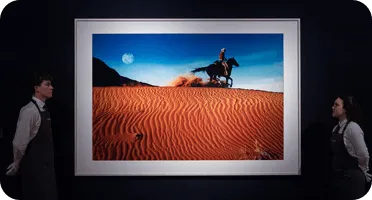
Photography is a unique art that can convey emotions and capture moments in time. Some pictures become not only works of art, but also objects of high value on the market. The most expensive photographs in the world are striking in their price and the story behind them. One of the most famous creators of such photographs is Andreas Gursky, whose works reach millions of dollars at auction. His photograph "Rhine" sold for a record-breaking $4.3 million.
Also worth mentioning is Greg Gorman, whose portraits of celebrities and movie stars have sold for significant sums. No less famous is Richard Prince, who creates unique works using elements of pop culture. His photograph "Untitled (Cowboy)" sold for $3.4 million.
Each of these photographs is not only highly valued but also has its own unique story and context, making them significant not only as works of art but also as investments. Thus, the photography market continues to grow, attracting the attention of collectors and investors around the world.
It is important to distinguish between a CV and a resume, as these are documents with different purposes. A resume is intended for job searches, while a CV is used when applying for exhibitions, festivals, and grants. A resume emphasizes your skills and experience that interest a potential employer or client and does not include your exhibition history. A resume is typically shorter than a CV and highlights the knowledge and experience needed to solve specific problems. A well-designed resume can significantly increase your chances of successful employment.
A CV is a document intended for curators, gallery owners, and photo editors, while a resume is aimed at clients and employers. The main difference between them is the target audience and the format for presenting information. A CV most often includes a detailed description of your artistic work, exhibitions, and publications, while a resume emphasizes your professional skills and experience that are relevant to potential employers. The correct design and content of each of these documents will help effectively convey information to interested parties and increase your chances of career success.
An Artist Statement is an essay in which the author expresses their views and philosophy. Unlike a resume, this document does not emphasize achievements and awards, but rather reveals the artist's inner world and creative principles. This text is written in simple and understandable language, allowing the reader to better understand the intentions and ideas behind the artwork. The Artist Statement helps establish a connection between the author and the viewer, deepening the perception of their work.
A CV is a factual biography of the author, containing the main events of their professional career. In contrast, an Artist Statement is a creative autobiography that conveys the artist's philosophy, reveals the themes of their work, and describes the methods they use. English: Both documents play an important role in presenting an artist, but they serve different purposes: a CV showcases professional achievements, while an Artist Statement helps to understand the artist’s inner world and creative process.
How to write a CV
- Length — 1–2 A4 pages, 12 font size.
- File format — DOC, DOCX, or PDF, depending on the application requirements.
- Align the document text to the left (otherwise there will be huge spaces).
Include your name or creative pseudonym, and full contact information. Include an email address, website, phone number, and postal address. Make your name stand out using bold or large font to make it stand out.
Ivanov Ivan Ivanovich is a name that can be associated with various fields of activity. He can be a professional in his field and also participate in public life. Ivan Ivanovich Ivanov exemplifies a person who strives for development and self-improvement. It is important to note that such individuals often play a significant role in their communities, contributing to various projects and initiatives. Possessing certain skills and experience, Ivan Ivanovich Ivanov may be of interest to both employers and potential partners.
Contact number: +7-999-99-99-55. We are ready to answer your questions and help you solve any problems. Call us to receive qualified assistance and support.
Professional HTML content editor. I specialize in creating and optimizing texts for websites, taking into account modern SEO standards. My goal is to improve the visibility of your content in search engines and attract your target audience. I provide high-quality editing, preserving the original meaning and focusing on keywords that will help your site rank higher. I always stay on top of current SEO and content marketing trends to achieve maximum results. If you need help with text optimization or unique content creation, please contact artist@website.com.
www.artistswebsite.com provides a unique platform for artists and creative people to showcase their work, exchange ideas, and find inspiration. We offer various avenues for self-expression, including galleries, blogs, and discussions. Our goal is to create a community of talented people and art lovers. Join us to discover new horizons in the art world and find like-minded people. We support artists at all stages of their careers, providing resources and tools to develop their creativity. Visit www.artistswebsite.com to learn more about our initiatives and events.
Moscow, Russia, 111552, Lenin Street, Building 16, Apartment 175.
Please provide your current residential address. Festivals and competitions often mail out catalogs of winners and shortlisted participants. Certificates and prizes may also be sent by mail. Please ensure your address is correct to avoid missing important materials and awards.
When composing your education section, we recommend following reverse chronological order: starting with your most recent educational institution and ending with your first. Be sure to include the year of graduation from each educational institution. This approach will help employers quickly assess your educational background and skill level.
- Institution Name - Degree - 2020;
- Other Institution Name - Degree - 2016.
If you do not have a formal art education, but have completed courses, be sure to list them in reverse chronological order. This will help demonstrate your skills and commitment to developing your artistic career. Mentioning your courses can increase your appeal to employers and demonstrate your commitment to learning and improvement. Internships are an important stage in the educational process. They provide students with the opportunity to apply theoretical knowledge in practice, acquire necessary skills, and gain work experience in a real-world setting. During internships, students work under the supervision of experienced professionals, which contributes to their professional development and deepens their understanding of their chosen specialty. Internships also allow them to establish connections with potential employers and learn about current industry trends. Thus, educational practice plays a key role in preparing qualified specialists ready for the challenges of the modern labor market.
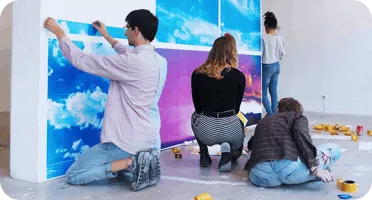
Learning new topics and obtaining information is an important aspect in our lives. Reading helps broaden our horizons and deepen our knowledge in various fields. Regular reading of literature, articles, and specialized sources contributes to the development of critical thinking and improves analytical skills. It also allows you to stay up to date with the latest trends and events. We encourage not only reading but also sharing interesting information with others, which promotes the exchange of knowledge and ideas.
Studying Photography Abroad: Key Considerations
Studying photography abroad opens new horizons for creative people seeking to develop their skills and gain international experience. The choice of country and institution is important, as it affects the quality of education and the cultural context. Explore programs offering courses in various fields, from fine art photography to photojournalism.
It's important to consider the language barrier. Many courses may be in English, so knowing the language will help you better understand the material and communicate with your instructors and fellow students. Consider taking a language course before starting your studies.
Financial considerations also play a key role. Consider tuition, accommodation, and additional expenses. Some universities and photography schools offer scholarships or financial aid, which can significantly ease your financial burden.
Don't forget about visa requirements. Research the process of obtaining a student visa in your chosen country to avoid problems upon entry. This is especially important if you plan to study for an extended period.
It's also helpful to familiarize yourself with the culture and traditions of the country you'll be studying in advance. This will help you adapt to new conditions and make the most of the opportunities that studying abroad provides.
Ultimately, studying photography abroad can be not only an important stage in your career, but also a unique experience that will enrich your life and creative views.
In this section, we will present professional experience and achievements in reverse chronological order. The block will be divided into subgroups for ease of perception and structuring of information.
- individual exhibitions;
- group exhibitions;
- awards;
- participation in art residencies;
- publications of the author's projects;
- press (critical articles about the author and their work and materials where the author acts as an expert);
- participation in conferences and other activities.
Pay attention to each point, devoting sufficient time to it and describing your experience in as much detail as possible. This will help create a clear and complete picture of your skills and achievements, which in turn will increase your chances of success. Detailing each aspect of your experience allows you to highlight key points and demonstrate your expertise.

Read also:
Photography Competitions in November 2024: 6 Best Opportunities for Talented Masters
November 2024 offers many exciting competitions for photographers looking to showcase their skills and gain recognition in the professional community. Participating in competitions not only allows you to improve your skills but also opens doors to new career opportunities. This month, we've rounded up six of the most notable competitions where photographers can prove themselves and win valuable prizes.
The first competition is an opportunity to showcase your work on an international stage. It's suitable for both professionals and amateurs, making it accessible to a wide audience. The second competition focuses on a specific theme, allowing participants to express their ideas and vision within a specific context. The third competition offers a unique platform for creating photo projects that can attract the attention of viewers and judges.
The fourth competition focuses on the use of innovative technologies in photography, offering a chance for those experimenting with new methods and styles. The fifth competition emphasizes the social significance of their work, allowing photographers to raise important topics and issues. Finally, the sixth competition offers the opportunity to collaborate with other creatives, which can enrich the participants' experience.
Participating in these competitions will not only increase the visibility of photographers but can also be an important step in their careers. Don't miss the chance to make a name for yourself and showcase your skills in November 2024.
If you don't have any exhibition experience, only highlight your photography skills, education, and photography internships. Avoid including irrelevant events in an attempt to pad your resume. For example, experience as an editor for a school newspaper or sewing courses won't help present you as a photography professional. Focus on factors that highlight your qualifications and experience in the field.
When you begin actively presenting your work, you may have several exhibitions in different cities within a month. Not all of them will be of equal importance, as some are organized to test projects and gauge audience reaction. As you accumulate positive experience participating in exhibitions and receiving awards, you can rename the "Group Exhibitions" section to "Selected Exhibitions." This section should include only the most significant events from your exhibition career, which will help highlight your professionalism and attract more attention to your work.
If you need to adapt your resume to specific application requirements, for example, if there is a character limit, it is advisable to exclude less significant exhibitions and publications. Shortening and editing your CV will help you focus on the key points of your experience and achievements, which will increase your chances of successfully passing the selection.
Pay attention to the grammar of your resume: carefully reread it to ensure there are no spelling and punctuation errors. Proper formatting will help create a positive first impression and increase your chances of successful employment.
A professional translation of the CV into English or another foreign language is performed by a qualified translator. A native speaker then carefully checks the result. If you decide to use a machine translation service, such as ChatGPT or DeepL, be sure to double-check the resulting translation. Pay particular attention to exhibition titles, city names, and project curator names to avoid errors and inaccuracies. Correct translation of these elements is crucial for the accurate presentation of your information.
If your resume requirements require a photo, choose one that clearly shows your face. Business or smart casual attire is ideal. This will create a positive impression of you as a candidate.
Regularly updating your resume is an important aspect of career development. We recommend updating your CV at least twice a year, as well as immediately after participating in exhibitions or publications. This will allow you to keep your achievements and experience current, which will significantly increase your chances of successful employment.
We recommend storing all documents in DOCX format. This simplifies the process of making changes to meet the requirements of each individual application. The DOCX format provides easy editing and compatibility with various text editors, making it an ideal choice for document preparation.
- Hobby exhibitions. These are exhibitions on very simple topics with low requirements for the quality of the photographs. Usually they have stereotypical names, for example, "Children - the Flowers of Life", "Ancient Traditions", "The Beauty of Nature".
- Exhibitions focused on commercial photography. Example: a wedding photography exhibition.
- Achievements not related to photography. Example: victories in a dance competition.
Key Mistakes in Working with a CV
Delegating tasks. It is not recommended to ask someone to prepare the document for you. If you are actively involved in creative work, exhibitions and publications will occur regularly. The document must be updated after each event. Therefore, it is wiser to master the process of creating it yourself once, which will allow you to effectively manage your materials and keep the information up to date.
Unreadable fonts can significantly impair the perception of the text. For example, using light gray on a white background or overly decorative fonts makes reading difficult. It's recommended to avoid "handwritten" fonts when formatting documents, as they can be distracting and make it difficult to understand the information. Correct font selection is an important aspect of text design and contributes to better perception and understanding of the content.
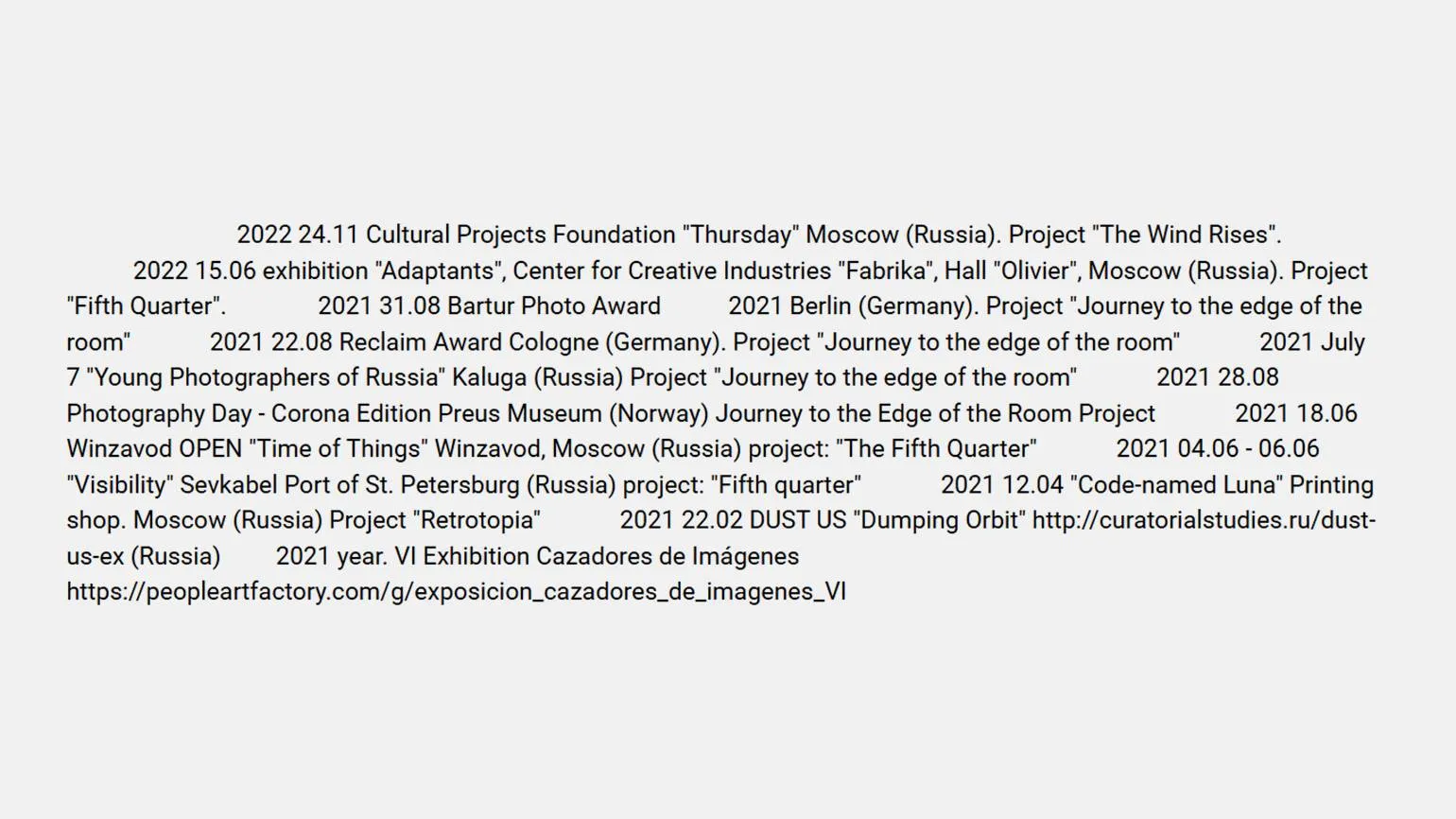
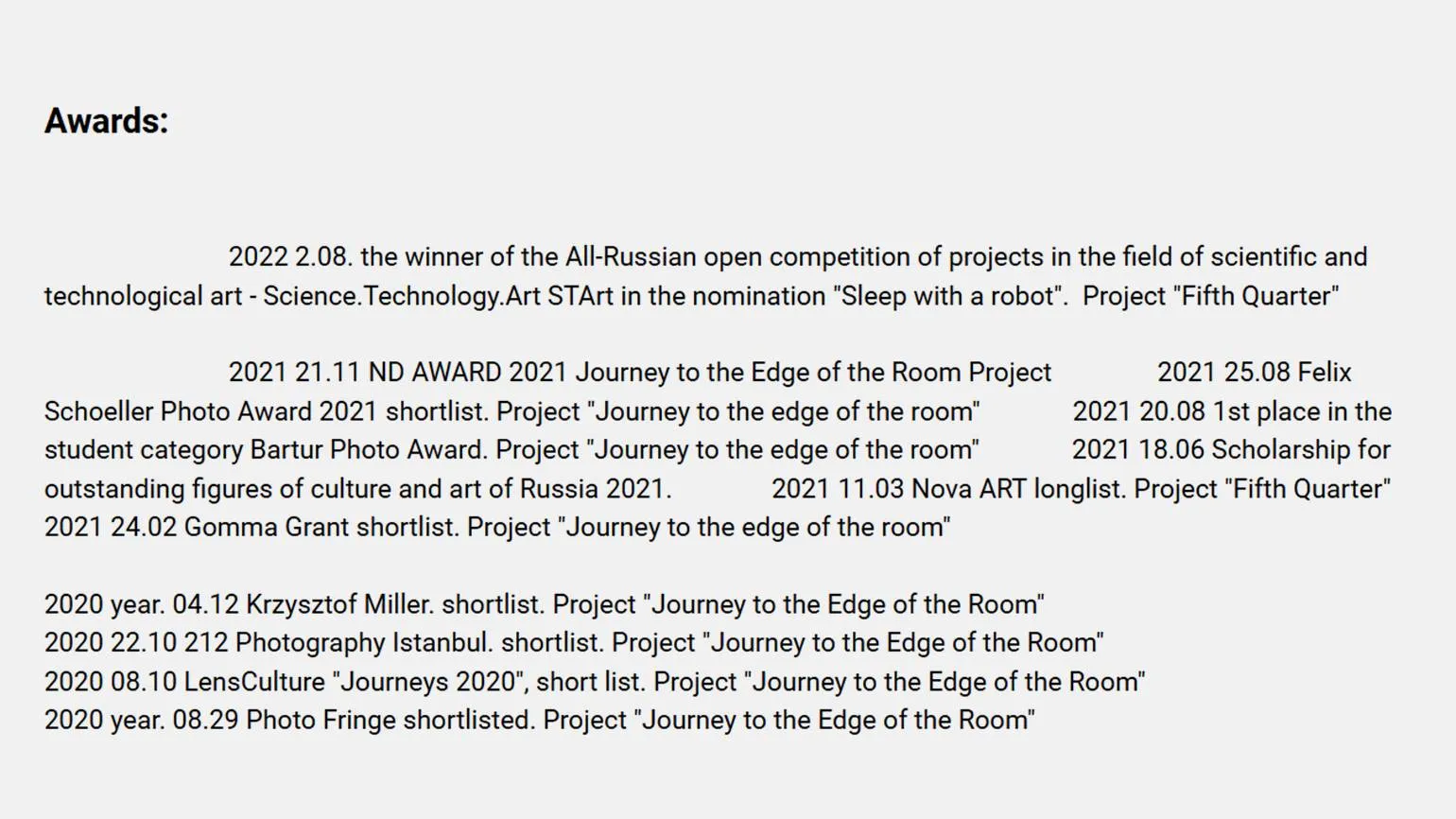
The author's photograph appears to be overly creative. For example, it may be blurry, taken from the background, or heavily processed. Such elements can distract from the main content and make it difficult to perceive. It is important that photographs are clear and crisp so viewers can focus on the main point. The aesthetics of the image should support the main idea, not contradict it.
Document Design. Avoid adding design elements, as they can distract from the main content and indicate a lack of understanding. Clean, simple text allows you to focus on the information, which is especially important for achieving the document's objectives.
Out of date. Authors often hold numerous exhibitions but fail to update their documents. As a result, despite new achievements and successes, their CV remains inappropriate and outdated, which can negatively impact career prospects. Regularly updating your CV allows you to effectively showcase your accomplishments and maintain a relevant professional image.
A poor-quality translation may contain errors that distort the meaning of the text when translated into another language. Such inaccuracies can negatively impact the comprehension of the document's content. It is important to ensure the accuracy and adequacy of the translation in order to preserve the original meaning and convey the necessary nuances.
Reading is an important part of our lives. It not only develops thinking, but also enriches our inner world. A good book can change the perception of reality and inspire new ideas. It is important to choose literature that matches your interests and helps expand your horizons. Regular reading helps improve concentration and memory, and reduces stress. Don't forget to share your impressions of the works you've read with friends; this can be a great opportunity for discussion and exchange of opinions. Pay attention to new genres and authors; this can open up unexpected perspectives and fascinating stories. Read to grow and develop.
Photography Project: The Importance of Planning and Its Goals
Planning a photography project is a key step that determines its success. A clear understanding of the goals and objectives allows you to create high-quality content that will attract attention and meet the expectations of the audience.
The first step in planning a photography project is defining the concept. You need to clearly formulate what exactly you want to convey to the viewer. This could be a specific theme, style, or mood. Then, it's worth developing a script, which will help structure the shooting process and avoid unnecessary waste of time and resources.
Choosing a suitable location for the shoot is also important. The location should correspond to the concept of the project and be comfortable for the participants. Don't forget about technical equipment: cameras, lighting, and accessories should be prepared in advance.
Also, it's worth paying attention to team selection. Photographers, models, stylists, and other specialists should be coordinated and informed about their roles in the project.
By planning your photo project, you not only increase its chances of success but also make the process more organized and efficient. This allows you to focus on creativity and achieve the desired result.
Profession Photographer
You will learn how to take professional photos from scratch. You will learn how to organize shoots, process shots, manage models and a team. Find your style, build an impressive portfolio, and start making money doing what you love.
Find out more